
How To
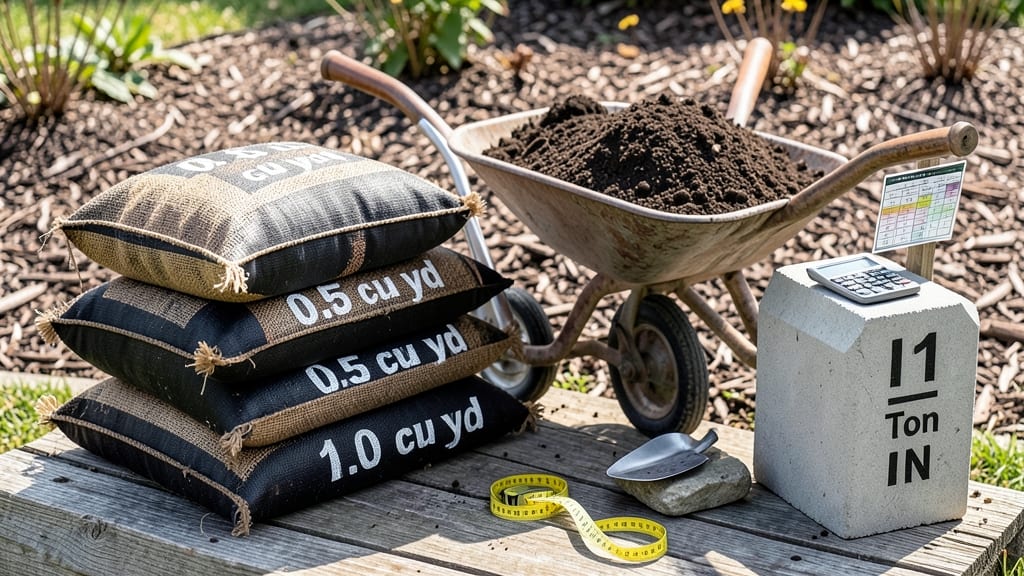
To convert tons of soil to cubic yards, remember that one ton equals roughly 0.75 to 1.2 cubic yards, with variations based on soil composition—loamy soil averages 1 cubic yard per ton, while sandy soil can reach up to 1.2 cubic yards, and clay-heavy soil may only yield 0.75 cubic yards or less.
Understanding this conversion is crucial because soil isn't uniform—its density shifts with moisture, organic matter, and particle size.
For example, a wheelbarrow full of dry, sandy soil will weigh less than the same volume of wet, clay-heavy dirt. 🌱 I always recommend testing a small batch first if you're working with unfamiliar soil types, as even a 10% moisture difference can alter your calculations significantly.
Most landscapers keep a reference chart handy to adjust estimates on the fly.
When planning a project, I suggest ordering 10-15% more soil than your calculations suggest to account for settling and compaction. A simple trick is to use a standard 3-cubic-foot shovel—three shovelfuls equal about 0.1 cubic yards, which helps visualize the volume before you buy.
For precise work, a tape measure and wheelbarrow with known dimensions become your best friends.
💡 In This Article
- Soil Density Variations and Their Impact on Cubic Yard Calculations
- Practical Conversion Tips for Gardeners and Landscapers
Soil density variations and their impact on cubic yard calculations
Soil density isn't one-size-fits-all—it's determined by three key factors: particle size, moisture content, and organic matter. Sandy soil, with its large particles and air gaps, typically weighs about 80-100 pounds per cubic foot, translating to roughly 1.2 cubic yards per ton.
On the opposite end, clay soil packs tightly with tiny particles and water retention, weighing 100-135 pounds per cubic foot, which shrinks its volume to 0.75 cubic yards per ton or less.
Loam, the balanced middle ground, sits at 90-110 pounds per cubic foot, giving it that 1 cubic yard per ton average.
The moisture level adds another layer of complexity. Wet soil can weigh 30-50% more than dry soil due to water's density (about 62.4 pounds per cubic foot), drastically altering your calculations.
For example, a ton of dry sandy soil might yield 1.2 cubic yards, but the same ton when saturated could shrink to 0.9 cubic yards because the water fills the air pockets.
This is why professionals always specify "dry weight" when ordering soil—moisture content can swing your volume estimates by 20-30%.
Compaction plays a sneaky role too. Loose, freshly tilled soil settles over time, losing 10-20% of its volume as particles shift. Imagine filling a wheelbarrow with fluffy topsoil—after a few days of settling, it might only occupy 80% of its original space.
This is why landscapers recommend ordering 10-15% extra to cover settling, especially for large projects like garden beds or lawn topdressing. The key is to account for both the soil's natural density and its compaction behavior.
Here's a quick reference for common soil types and their weight-to-volume ratios:
- Sandy soil: 1.1-1.2 cubic yards per ton (low density, large particles)
- Loamy soil: 1.0 cubic yard per ton (balanced, ideal for gardening)
- Clay soil: 0.75-0.9 cubic yards per ton (high density, fine particles)
- Peat moss: 0.5-0.7 cubic yards per ton (very light, high organic matter)
For the most accurate estimates, I always recommend testing a small batch. Fill a 5-gallon bucket (about 0.11 cubic feet) with your soil, weigh it, then calculate the pounds per cubic foot.
Multiply that by 27 cubic feet per yard to get your per-ton volume. This hands-on approach beats guessing, especially when working with mixed or unknown soil types.
One final pro tip: If you're dealing with organic-heavy soils (like compost blends), expect even greater volume swings. A ton of pure compost can occupy 1.5-2 cubic yards due to its fibrous, airy structure—so always confirm the material's composition before ordering.
Understanding these variations saves time, money, and frustration in the long run!