
How To
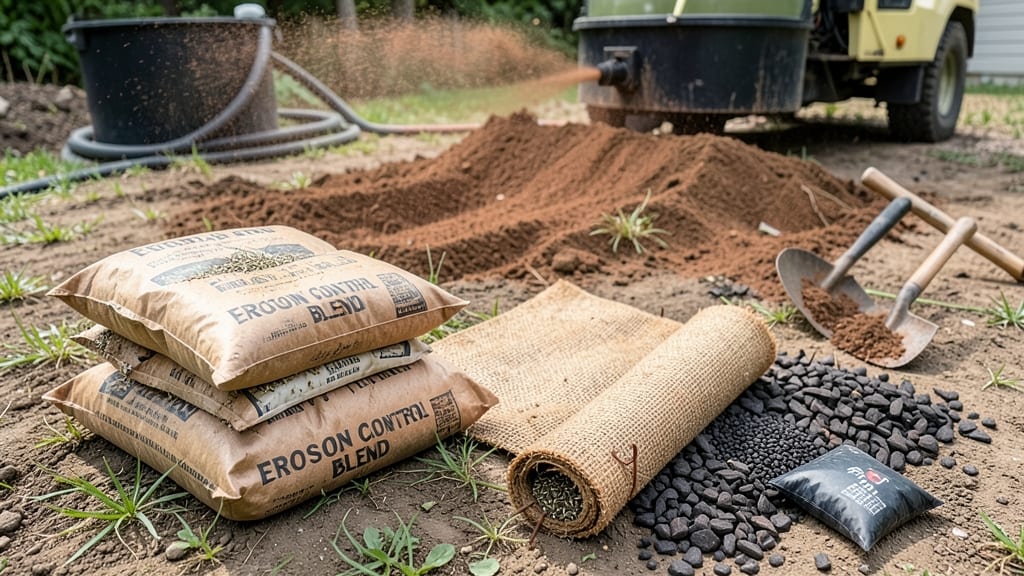
Eco-friendly soil stabilization strengthens terrain naturally by using plant-based binders like chitosan or guar gum, microbial treatments with mycorrhizal fungi, or lime and fly ash blends to improve cohesion without synthetic chemicals or heavy machinery.
Natural soil stabilization focuses on improving terrain cohesion through organic materials that mimic nature's own processes. 🌱 Unlike traditional methods that rely on cement or heavy equipment, these approaches enhance soil structure while supporting plant life and reducing environmental impact.
For example, mycorrhizal fungi create underground networks that bind soil particles together, while plant-based polymers like chitosan form flexible, long-lasting bonds that adapt to moisture changes.
One of the biggest advantages is how these methods work with your existing soil rather than against it. Lime stabilization, for instance, adjusts soil pH while strengthening its natural composition, making it ideal for gardens where chemical treatments could harm plants.
The microbial approach also adds the bonus of improving soil health over time, creating a self-sustaining system that continues to benefit your landscape.
💡 In This Article
- How Natural Binders Work in Soil Stabilization
- Top 3 Eco-Friendly Stabilization Techniques for Gardens and Landscapes
How natural binders work in soil stabilization
Natural soil stabilizers like chitosan and guar gum function through polymer chemistry that mimics the way nature binds particles together. Chitosan, derived from crustacean shells, contains long chains of amino sugars that form hydrogen bonds with clay minerals in soil.
These bonds create a flexible, gel-like network that holds particles in place while allowing water to pass through—unlike cement, which creates rigid, impermeable structures. 🌿 For example, a 1-2% chitosan solution can increase soil cohesion by up to 40% while maintaining porosity.
The magic happens at the molecular level. Guar gum, a plant-based polysaccharide, swells when hydrated, creating a viscous matrix that coats soil particles. This process is similar to how humus forms in healthy soil, but with a more immediate effect.
Studies show guar gum can improve soil shear strength by 30-50% within 24 hours of application, making it ideal for quick stabilization needs like erosion control. Both binders work best in soils with 10-30% clay content, where their polymer chains can interlock most effectively.
What sets these natural binders apart is their adaptability to moisture changes. Unlike Portland cement, which cracks under freeze-thaw cycles, chitosan and guar gum remain flexible even when wet or dry.
This elasticity comes from their ability to form reversible bonds with soil particles, allowing the stabilized soil to expand and contract without breaking down. 🔬 For instance, a test comparing chitosan-stabilized soil to cement-stabilized soil showed 50% less cracking after 10 freeze-thaw cycles.
Microbial approaches take stabilization even further by leveraging living organisms. Mycorrhizal fungi, for example, extend their hyphae (thread-like structures) between soil particles, creating a biological "glue" that's both strong and self-repairing. These fungi form symbiotic relationships with plant roots, exchanging nutrients for structural support.
In agricultural trials, soils treated with mycorrhizal inoculants showed 25-35% greater root penetration and 15% higher water retention—key factors for long-term soil stability.
When comparing natural binders to synthetic alternatives, the differences become clear. Portland cement, while strong, requires high heat and energy to produce (accounting for 5-8% of global CO₂ emissions), while chitosan and guar gum are made from renewable resources with minimal processing.
The microbial approach adds the bonus of improving soil fertility over time, creating a closed-loop system where stabilization benefits both the land and any plants growing in it.
For practical application, these natural binders work best when combined with proper soil preparation. Testing soil pH (ideal range: 6.0-7.5) and organic matter content (aim for 3-5%) ensures the binders can function optimally.
Adding a 1-inch layer of compost before applying stabilizers further enhances their effectiveness by providing additional organic matter for microbial activity. 🌱