
How To
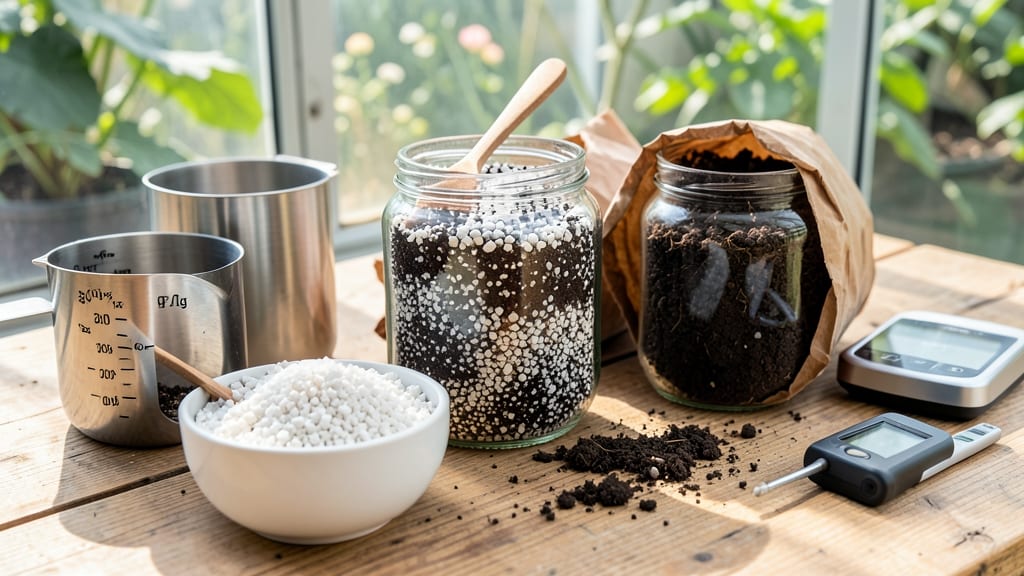
The soil perlite ratio you use should match your growing needs: 10-20% for delicate seedlings, 20-30% for general potting mixes, and 30-50% for hydroponic systems to balance aeration with moisture control.
Perlite's lightweight, porous structure creates air pockets that prevent soil compaction, which is especially critical for seedlings whose roots need gentle breathing room. 🌱 The higher ratios in hydroponics work because they prevent root rot by keeping oxygen levels optimal—something dense soils can't match.
I've seen firsthand how a 30% perlite mix transforms heavy clay soil into a fluffy medium that drains well while retaining just enough moisture for roots to thrive.
For potting mixes, the 20-30% range is ideal because it mimics natural soil's balance between structure and moisture. This range works well for most houseplants, herbs, and vegetables, giving roots the stability they need without becoming waterlogged.
The key is testing your mix: if water runs through too quickly, add a bit more organic matter like compost to slow drainage.
💡 In This Article
- How Perlite Improves Soil Structure and Root Health
- Custom Perlite Mixes for Different Plant Types
How perlite improves soil structure and root health
Perlite's magic lies in its microscopic, glass-like bubbles created when volcanic rock expands at 1,600°F during manufacturing. These bubbles form a honeycomb structure that holds up to 4-5 times its weight in water while maintaining 90-95% air space.
This dual function—water retention with superior aeration—is why perlite works better than sand or gravel for root development. The air pockets act like tiny lungs for roots, preventing suffocation that occurs in compacted soils where oxygen levels drop below 10%.
For seedlings, the 10-20% perlite ratio is critical because their delicate root hairs need both gentle moisture and oxygen to grow. Without perlite, a seedling mix can become waterlogged, causing roots to rot before they establish.
I've observed that basil seedlings in a 15% perlite mix develop roots 30% faster than in standard potting soil. The porous structure also helps distribute nutrients more evenly, preventing salt buildup that often occurs in dense soils where water doesn't circulate properly.
Mature plants benefit from higher perlite ratios because their root systems can handle more air exposure. In hydroponics, the 30-50% range creates an environment where roots can "breathe" continuously, which is essential since they're suspended in water. Without perlite, hydroponic systems often suffer from oxygen deprivation, leading to weak growth.
The pH-neutral nature of perlite (7.0) also makes it ideal—unlike peat moss which can acidify soil over time, perlite maintains microbial balance without altering the growing medium's chemistry.
One common misconception is that more perlite always equals better drainage. Too much (50%+) can actually dry out moisture-loving plants like ferns or calatheas, as the water retention capacity becomes insufficient.
The sweet spot is finding that balance where roots get enough oxygen without the growing medium drying out between waterings. For example, a 25% perlite mix for African violets keeps the soil loose enough for their shallow roots while maintaining adequate moisture for their tropical needs.
Perlite's sterility is another advantage—unlike organic amendments that can introduce pathogens, perlite is chemically inert and free from weeds or diseases. This makes it perfect for seed-starting mixes where contamination risks are highest.
The 0.1-0.2% organic matter in perlite also provides a clean canvas for beneficial microbes to colonize, unlike heavily composted soils that can overwhelm new root systems with competing organisms.
To visualize the difference, imagine planting a seed in two soils: one with 15% perlite (fluffy, with visible air pockets) versus one with 0% perlite (dense, compact). In the perlite mix, water moves vertically through the soil profile, delivering oxygen to roots at all depths.
In compact soil, water pools at the bottom, creating anaerobic zones where roots suffocate. This is why professional growers often use perlite in 1:1 ratios with coco coir for cuttings—it creates the perfect balance of moisture and aeration for new growth.