
Tools
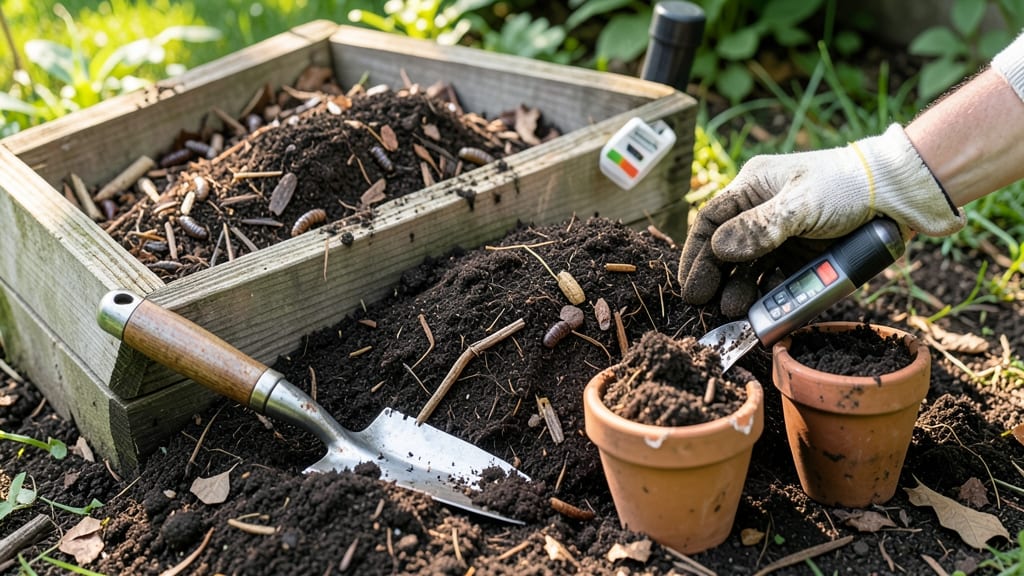
Understanding garden soil and compost reveals their distinct roles: garden soil forms the foundation for roots with its mineral-rich structure and drainage capacity, while compost acts as a nutrient booster that enhances fertility and microbial life, but never fully replaces soil's structural benefits.
These two garden essentials work together like a dynamic duo, each bringing unique strengths to your plants. 🌱 Garden soil contains essential minerals and a balanced mix of sand, silt, and clay that create the perfect environment for root systems to thrive, while compost—made from decomposed organic matter—adds vital nutrients and improves soil structure over time.
Think of soil as the sturdy foundation of a house and compost as the premium topsoil that makes gardens flourish.
For best results, I always blend them in a 3:1 ratio (soil to compost) when preparing planting beds, though container gardens often benefit from a 50/50 mix for faster nutrient delivery.
The key is understanding when to use each separately—compost alone works great for mulching or amending poor soil, while garden soil provides the essential structure that roots absolutely need to anchor and grow.
💡 In This Article
- How Soil Composition Differs from Compost Structure
- Best Ways to Mix Soil and Compost for Healthy Gardens
How soil composition differs from compost structure
Garden soil is a complex ecosystem containing roughly 45% minerals (like sand, silt, and clay), 25% water, 25% air, and only about 5% organic matter in healthy topsoil.
The mineral content provides the structural framework that supports plant roots, while the clay particles (0.002mm or smaller) hold nutrients and moisture through electrostatic charges. This mineral matrix creates the perfect balance of aeration and water retention—critical for root respiration and nutrient uptake. 🌱
Compost, on the other hand, is primarily decomposed organic matter (leaves, grass clippings, food scraps) that has broken down into humus—a dark, crumbly substance rich in nutrients like nitrogen, phosphorus, and potassium. Unlike soil, compost contains 50-70% organic matter with minimal mineral content, making it lightweight and fluffy.
Its high microbial activity (thousands of beneficial bacteria and fungi per gram) accelerates nutrient cycling, but lacks the structural stability to support roots alone. Think of compost as a nutrient powerhouse that feeds soil microbes, which in turn release plant-available nutrients.
The physical textures also differ dramatically: soil feels gritty or smooth depending on its clay/sand ratio, while compost has a spongy, almost velvety texture that crumbles easily between fingers.
This structural difference explains why compost alone can't replace soil—roots need the rigid mineral framework to anchor themselves, while compost provides the fertile "food" that keeps plants thriving. For example, a 10% compost addition to clay-heavy soil can improve drainage by 30-40% while increasing microbial activity by 500%.
Another key difference lies in their pH levels: most garden soils range between 6.0-7.5 (slightly acidic to neutral), while fresh compost typically sits around 7.0-8.5 (neutral to alkaline). This pH shift occurs during decomposition when microbes consume nitrogen, creating a temporary alkaline environment.
Over time, mature compost stabilizes closer to 6.5-7.0, making it ideal for amending acidic soils. The microbial diversity in compost also helps buffer soil pH fluctuations, creating a more stable growing environment.
Consider how these differences play out in real-world scenarios: when planting tomatoes, you'd mix 70% soil with 30% compost to provide both structural support and nutrient density. The soil's mineral content anchors the heavy fruit while the compost's microbial activity ensures consistent nutrient supply throughout the growing season.
Without that soil framework, the roots would struggle to support the plant's weight and water needs, even with abundant compost.
For container gardens, the contrast becomes even more apparent: a 50/50 mix of soil and compost works well because the limited root space requires maximum nutrient density, but the soil component prevents compaction that would suffocate roots.
In raised beds, you might layer 6 inches of soil at the bottom for structure, topped with 3 inches of compost—this creates an ideal gradient where roots can access both stability and nutrients as they grow downward. 🌿