
Vegetables
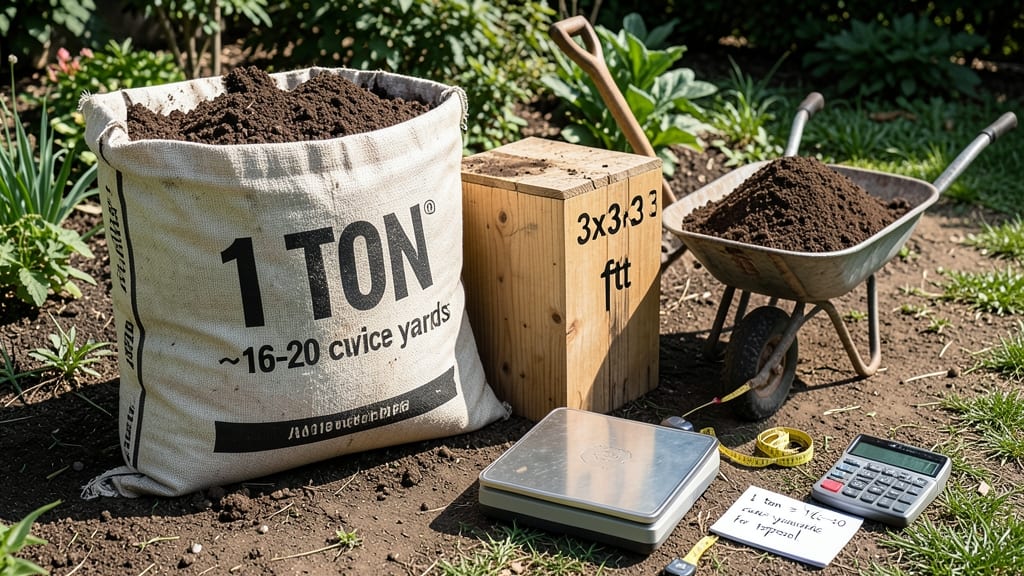
To determine how many yards of topsoil are in a ton, know that a ton typically covers 0.45 to 0.6 cubic yards—or 12 to 16 cubic feet—with variations based on soil density. Loose, organic-rich topsoil expands more than compacted or clay-heavy blends. Always confirm supplier specs before ordering for accurate project planning.
Understanding topsoil volume is all about density—moisture, organic matter, and compaction play huge roles. 🌱 A bag of loose garden soil might measure 1.5 cubic feet per pound, while tightly packed clay-heavy soil could shrink to just 0.8 cubic feet per pound.
This means your 1-ton order could range from 12 to 16 cubic feet depending on what you're working with. For landscaping, I always recommend calling your supplier to ask for their specific cubic yard per ton ratio—they often test batches to give you precise numbers.
Why does this matter? Because ordering too little means extra trips, while overestimating wastes money and storage space. For example, a 10'×10' raised bed filled to 6 inches deep needs about 0.3 cubic yards—so you'd want roughly 0.75 tons of standard topsoil.
The key is measuring your project area first, then adjusting for your soil type's density. Most suppliers will help with conversions if you share your project dimensions.
💡 In This Article
- Topsoil Density Factors Affecting Cubic Yards per Ton
- Calculating Topsoil Needs for Garden Beds and Landscaping
Topsoil density factors affecting cubic yards per ton
The weight-to-volume ratio of topsoil depends on three key factors: moisture content, organic matter percentage, and compaction level. Moisture alone can change volume by up to 20%—dry soil weighs more per cubic foot than damp soil, which contains air pockets.
For instance, screened topsoil with 15% moisture typically measures 1.3 cubic feet per pound, while clay-heavy blends at 25% moisture may only reach 0.9 cubic feet per pound. This explains why a "ton" of clay soil covers less area than organic-rich garden soil.
Organic matter plays a dramatic role too. Peat-based or compost-amended topsoil contains 30-50% organic material, which creates light, airy structures that expand when dry. Compare this to mineral-heavy topsoil (like loam) with only 5-10% organics10-15% less volume per ton.
I've seen suppliers offer "bulk" topsoil that's 60% sand by weight—this can cut cubic yards per ton by nearly 30% compared to standard garden soil.
Compaction makes all the difference in real-world projects. A freshly tilled garden bed has 30-40% air space, while the same soil after being walked on or rained upon can lose 15-20% volume.
This is why landscapers recommend ordering 10-15% more than calculated for projects like sloped yards or heavily trafficked areas. For example, a 500 sq ft lawn needing 4 inches of topsoil would require 0.85 cubic yards of loose soil, but only 0.75 cubic yards of compacted clay-heavy mix.
Here's how different soil types compare in cubic feet per pound:
- Screened garden soil: 1.3-1.5 cubic feet/lb (high organic matter, loose)
- Standard topsoil: 1.0-1.2 cubic feet/lb (balanced organic/mineral)
- Clay-heavy blend: 0.8-1.0 cubic feet/lb (compacted, low organic matter)
- Peat moss mixes: 1.6-1.8 cubic feet/lb (very light, high air content)
Most suppliers use 1.2 cubic feet per pound as their standard for "topsoil," but always ask for their tested density. I once ordered 2 tons of what I thought was garden soil—turned out to be 60% sand, and my 10'×20' bed only got covered halfway!
The lesson: when in doubt, request a sample first and measure its expansion.
For precise planning, multiply your project's cubic yards by 1.1-1.2 as a safety buffer. This accounts for settling, uneven distribution, and the inevitable "just in case" needs that pop up mid-project. 🌱