
Lawn
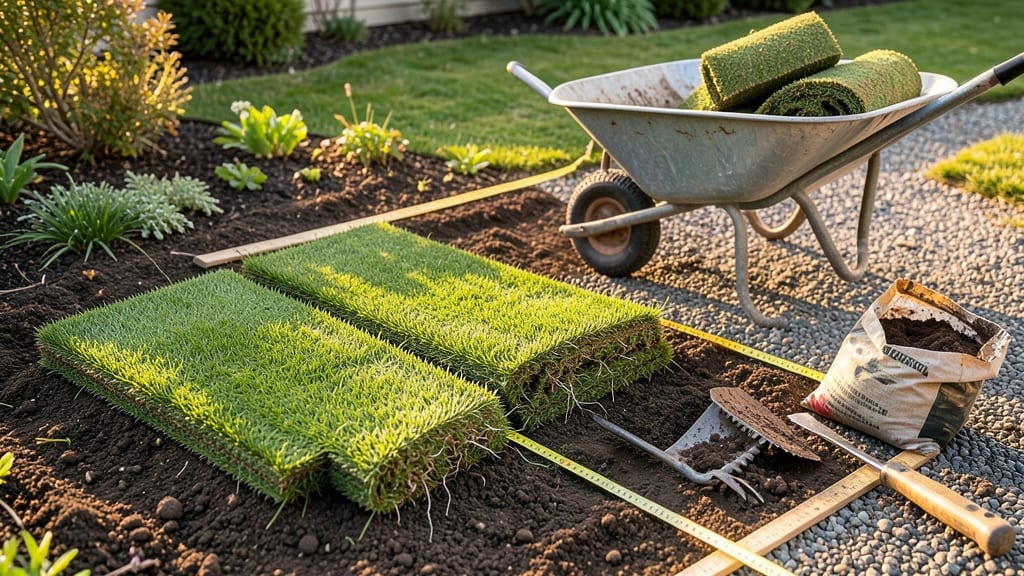
To determine how much topsoil for sod, spread 2 to 4 inches evenly across the prepared ground to balance root contact, drainage, and nutrient access while preventing compaction or smothering the grass roots. Adjust the depth based on your existing soil conditions and the thickness of your sod rolls.
This 2- to 4-inch layer creates the perfect foundation for your new sod—thin enough to avoid suffocating roots but thick enough to support healthy growth from the start. 🌱 The ideal depth helps prevent waterlogging while allowing roots to penetrate naturally into the subsoil below.
If your existing soil is particularly rocky or compacted, you might lean toward the deeper end of the range, but always level the surface before laying down your sod to ensure even coverage.
For a 100-square-foot area, you'll typically need about 1 cubic yard of topsoil at a 3-inch depth. Always account for slope and any soil amendments you plan to mix in, as these can affect both volume needs and cost.
A simple calculation—length × width × depth—will give you the exact amount required for your project.
💡 In This Article
- Why Topsoil Depth Matters for Sod Growth
- Calculating Topsoil Volume for Your Sod Project
Why topsoil depth matters for sod growth
Think of topsoil as the first layer of your sod's life support system—it's where roots establish their initial connection to nutrients, water, and oxygen. The ideal 2- to 4-inch depth creates a Goldilocks zone: thick enough to hold moisture and nutrients while thin enough to prevent suffocation.
Grass roots need oxygen for respiration, and compacted soil blocks this exchange. A 3-inch layer provides enough space for roots to spread horizontally while still reaching down to the subsoil below, where deeper moisture and stability reside.
Here's the science: Grass roots grow best when they can penetrate 4-6 inches deep within the first 2 weeks. A 2-inch topsoil layer might work for thin sod rolls, but it risks exposing roots to temperature fluctuations and drying out too quickly.
On the other hand, 5+ inches creates an anaerobic (oxygen-poor) zone at the bottom, where roots can rot. The 2-4 inch range balances this perfectly, allowing roots to bridge the gap between topsoil and subsoil naturally. 🌱
Moisture retention is another critical factor. Topsoil with 30-50% organic matter holds water like a sponge while still allowing drainage. Sandy soils might need the 4-inch depth to prevent rapid drying, while clay-heavy soils benefit from 2-3 inches to avoid waterlogging.
The texture of your topsoil—whether it's loamy, sandy, or silty—directly affects how quickly water drains and how easily roots can push through. A simple finger test can reveal your soil's drainage: Press a handful—if it crumbles easily, it drains well; if it stays clumped, it's too dense.
Nutrient availability also depends on depth. The top 1 inch of soil contains the highest concentration of microorganisms and organic matter, but roots need to access these resources without being buried too deep. A 3-inch layer ensures roots can reach this nutrient-rich zone while still having room to grow downward.
This is why professional landscapers often recommend amending the topsoil with compost or fertilizer—it creates a nutrient gradient that supports root development from day one.
Common mistakes happen when homeowners either skimp or overdo the depth. I've seen projects where 1-inch layers were used, leading to patchy growth as roots struggled to establish. Conversely, 6-inch layers created a barrier that prevented roots from reaching the moisture-rich subsoil below.
The key is to use a level to ensure an even surface—uneven topsoil means uneven root growth and potential water pooling in low spots.
One pro tip: If your existing soil is rocky or compacted, consider a 3-inch topsoil layer with a 1-inch layer of compost mixed in**. This improves drainage while adding organic matter that breaks down over time, enriching the soil naturally.
The compost acts like a sponge, holding water and nutrients right where the roots need them most. 💫