
How To
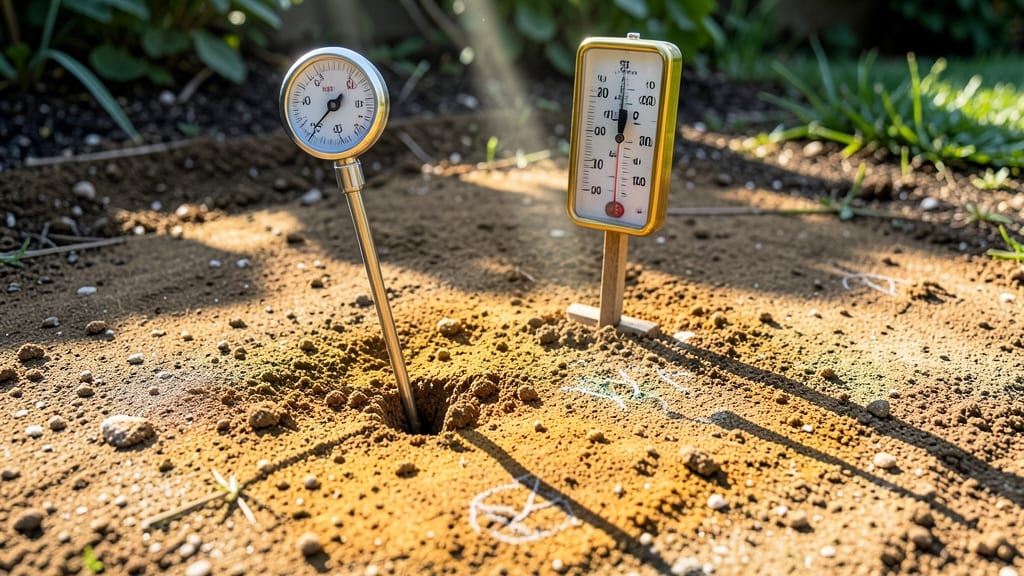
Soil temperature is warmer than air during the day because it absorbs and retains heat from sunlight more efficiently, creating a stable environment that supports root growth and seed germination.
This happens because soil has a higher specific heat capacity than air, meaning it stores heat longer and releases it gradually.
Unlike air, which cools quickly after sunset, soil maintains warmth overnight. 🌱 For gardeners, this stability is key—roots thrive in consistently warm soil, while seeds often need specific temperature ranges to sprout properly.
Understanding this difference helps explain why spring planting times vary by region and why mulching can extend growing seasons.
For example, in cooler climates, soil may stay warm enough for planting weeks before air temperatures are consistently mild. This is why gardeners often rely on soil thermometers rather than air thermometers when deciding when to plant heat-sensitive crops like tomatoes or peppers.
💡 In This Article
- Why Soil Warms Faster Than Air: Heat Absorption Science
- How Soil Temperature Affects Plant Growth and Gardening Choices
Why soil warms faster than air: heat absorption science
Soil absorbs heat more efficiently than air because of its higher specific heat capacity—the amount of energy needed to raise its temperature. Dry soil can hold roughly 0.2 calories per gram per °C, while air only holds about 0.0003 calories per gram per °C.
This means soil soaks up sunlight like a sponge, converting solar radiation into stored heat that radiates back slowly. 🌞 During daylight hours, exposed soil surfaces can reach temperatures 10-20°F warmer than the surrounding air, especially in dry conditions.
The lack of convection in soil plays a crucial role too. Unlike air, which circulates and disperses heat quickly through wind and currents, soil's solid particles trap heat near the surface.
Moisture content further influences this—wet soil conducts heat 2-3 times faster than dry soil due to water's high thermal conductivity, but it also cools more gradually at night. This is why gardeners often see morning frost on dry soil while nearby moist areas remain frost-free.
Another key factor is albedo—how much light a surface reflects. Dark, organic-rich soil absorbs 80-90% of sunlight, while light-colored sand reflects 30-40%. This explains why garden beds stay warmer than gravel paths under identical sun exposure.
The deeper layers of soil also act as an insulator, preventing rapid heat loss to underlying cooler earth—a phenomenon known as the "soil heat budget."
For practical observation, place your hand near the ground on a sunny day—you'll notice the air just above the surface feels noticeably warmer than the air at waist height.
This ground-level heat layer is where most plant roots thrive, explaining why shallow-rooted crops like lettuce and radishes often grow better in soil than in containers where heat escapes faster. 🌱 The stable warmth also creates ideal conditions for microbial activity in the root zone, breaking down organic matter more efficiently.
Contrast this with air, which has no thermal mass—it heats and cools almost instantly with temperature changes. A breeze can drop air temperature 5-10°F in minutes, while soil may take hours to cool.
This thermal lag is why gardeners in temperate zones can plant frost-sensitive crops like basil weeks before air temperatures consistently stay above 50°F—the soil provides the stable warmth roots need to establish.
Understanding these mechanisms helps explain why mulching works so well. Organic mulches like straw or wood chips create an insulating layer that slows heat loss from soil, maintaining warmer temperatures for longer—especially valuable in early spring when air temps may still dip at night.
This insulation effect can raise soil temperatures by 2-5°F** compared to unmulched beds. 🌿