
Vegetables
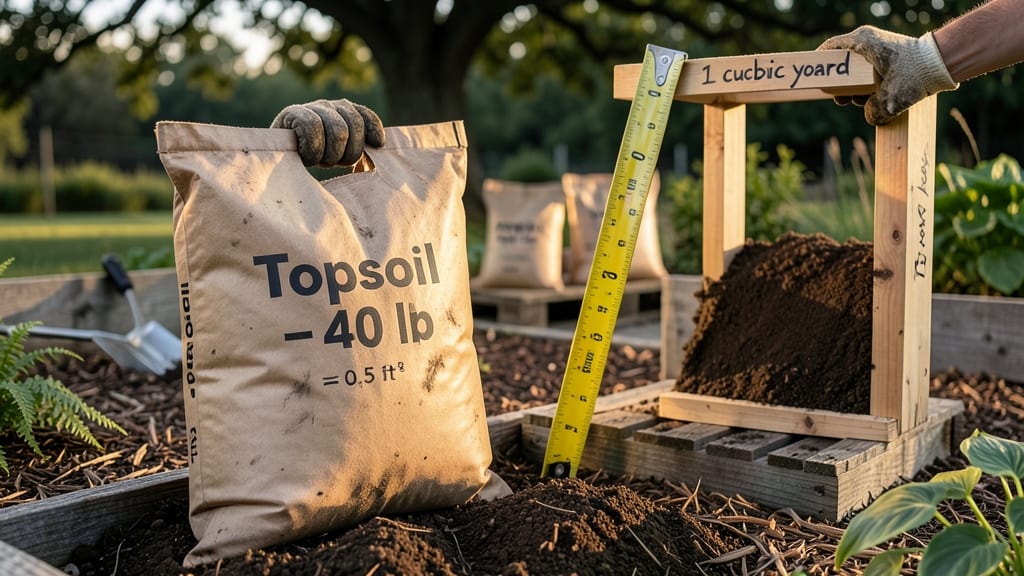
A 40 lb bag of topsoil covers about 0.4 to 0.5 cubic feet (0.014 to 0.018 cubic yards), making it ideal for small garden beds or seedling areas. The exact coverage depends on how compacted the soil is and its moisture level.
A 40 lb bag of topsoil delivers surprisingly little volume because soil is surprisingly heavy—its weight comes from minerals and moisture, not just air space. 🔥 For example, a 1 cubic yard of topsoil can weigh between 1,800 and 2,200 lbs, meaning your bag is just 1.8% to 2.2% of that volume.
This explains why gardeners often need multiple bags for even small projects like raised beds or vegetable patches.
To put this into practical terms, that same 0.014 to 0.018 cubic yards would cover about a 2' x 2' area at just 2 inches deep—perfect for planting flowers or herbs.
If you're working with deeper layers or larger spaces, you'll need to calculate total cubic yards first by multiplying length × width × depth, then divide by 27 (since 1 cubic yard = 27 cubic feet).
💡 In This Article
- How Topsoil Weight Converts to Cubic Yards
- Calculating Topsoil Needs for Garden Projects
How topsoil weight converts to cubic yards
The conversion from weight to volume in topsoil depends on its bulk density, which measures how tightly packed the particles are.
Loose, airy topsoil (like freshly delivered bags) has a bulk density of about 60-70 lbs per cubic foot, while compacted soil can reach 90-100 lbs per cubic foot.
This explains why a 40 lb bag expands to 0.4-0.5 cubic feet—it's not just dirt, but a mix of minerals, organic matter, and air pockets that lighten the weight. 🔥
Moisture content plays a critical role too. Dry topsoil weighs more per cubic foot than moist soil because water fills the air gaps, reducing overall volume. For example, a bag labeled "40 lbs" might actually contain 35 lbs of dry soil plus 5 lbs of water when freshly mixed.
This variability is why some brands specify "dry weight" or "wet weight" on their bags—always check the label to avoid underestimating your needs.
The standard conversion formula for topsoil is 1 cubic yard = 27 cubic feet, but weight-to-volume ratios differ by brand. Premium topsoil with higher organic content (like compost blends) often weighs 1,500-1,800 lbs per cubic yard, while standard garden soil can exceed 2,200 lbs per cubic yard.
This means your 40 lb bag represents just 0.018-0.027 cubic yards—a tiny fraction of a full yard, which is why gardeners need to plan carefully.
What most people don't realize is that settling occurs after spreading. When you lay down topsoil, it naturally compacts under its own weight or from foot traffic, reducing volume by 10-20%.
For instance, a 2-inch layer of loose soil might settle to 1.6-1.8 inches once compacted. This is why professional landscapers recommend ordering 5-10% more soil than your calculations suggest.
Consider this real-world example: A 4' x 8' garden bed filled to 6 inches deep requires 1.78 cubic yards of topsoil. At 0.018 cubic yards per 40 lb bag, you'd need about 99 bags—or roughly 100 bags accounting for settling.
That's why many gardeners opt for bulk deliveries (like 1 cubic yard pallets) for larger projects, as they're far more cost-effective than buying individual bags.
For precise planning, use this quick reference:
- Loose topsoil: 40 lbs ≈ 0.5 cubic feet ≈ 0.018 cubic yards
- Compacted topsoil: 40 lbs ≈ 0.4 cubic feet ≈ 0.014 cubic yards
- Moisture adjustment: Add 10-15% more volume if soil is damp
- Settling factor: Increase total volume by 5-10% for post-spreading compaction