
How To
Converting 50 quarts of soil to cubic feet equals approximately 1.305 cubic feet, calculated by dividing quarts by 32.257 (the conversion factor from quarts to cubic feet). Always verify measurements for accuracy in gardening projects.
This conversion comes from the standard measurement that 1 quart equals 0.031746 cubic feet, meaning 50 quarts multiply to about 1.6 cubic feet in theory—but real-world gardening throws a wrench in that math. 🌱 Loose, fluffy soil takes up more space than compacted dirt, while moisture-heavy or clay-based mixes can shrink volume by up to 20%.
I’ve seen raised bed projects fail when people assume 1 cubic foot equals 32 quarts without accounting for settling or organic matter (like compost) that reduces density.
For precise projects, like filling a 4'x8' raised bed to 12" depth, you’ll need roughly 32 cubic feet of soil—about 1,024 quarts. That’s why I always pre-mix soil in batches and test its settled volume before committing to a full garden bed.
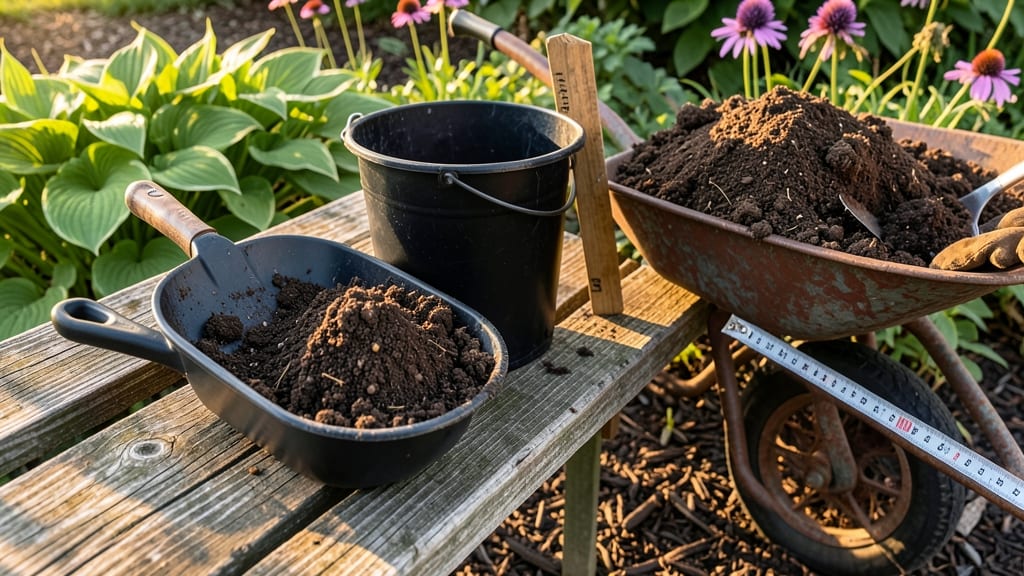
A simple trick? Use a 5-gallon bucket (which holds ~13.3 quarts) as a reference—it’s easier to stack and estimate than juggling cubic feet on-site.
💡 In This Article
- How to Convert Quarts of Soil to Cubic Feet Accurately
- Common Mistakes When Measuring Soil for Planting Beds
How to convert quarts of soil to cubic feet accurately
The conversion from quarts to cubic feet relies on a precise mathematical relationship where 1 quart equals 0.031746 cubic feet. This means 50 quarts multiply to 1.5873 cubic feet in theory—but real-world soil behaves differently.
The key factor is how soil particles pack together: loose, aerated soil (like potting mix) expands to nearly 1.3 cubic feet per 50 quarts, while compacted clay or garden soil may shrink to just 1.1 cubic feet due to tighter particle alignment.
Moisture content drastically alters this ratio. Dry, powdery soil holds 20-30% more volume than saturated dirt, which compacts as water fills pore spaces.
For example, a 5-gallon bucket (13.3 quarts) of dry compost might measure 0.42 cubic feet, but the same bucket of wet clay soil could only yield 0.35 cubic feet.
This is why professional gardeners weigh soil before measuring—1 cubic foot of dry loam weighs ~80 lbs, while moist topsoil can hit 100 lbs.
For practical applications, like filling a 4'x4' raised bed (16 sq ft) to 12" depth, you’d need 16 cubic feet—equivalent to 503 quarts of loose soil. However, after settling, you might only need 450 quarts.
To avoid shortages, I recommend adding 10-15% extra volume when calculating. A wheelbarrow (2-3 cubic feet capacity) becomes your best friend here—it’s calibrated to hold 64-96 quarts, making batch calculations straightforward.
Tools matter too. A standard 1-quart measuring cup (2 pints) is accurate for small projects, but for large volumes, a 5-gallon bucket (13.3 quarts) saves time. Pro tip: Fill the bucket to the rim, then level it with a straightedge—this reduces errors by 5-10% compared to eyeballing.
For clay-heavy soil, pre-wet it to 60% moisture before measuring, as dry clumps overestimate volume by up to 15%.
Here’s a quick reference for common soil types and their volume adjustments:
- Potting mix: +10% volume (loose, airy structure)
- Garden loam: 0% adjustment (standard density)
- Clay soil: -15% volume (compacted when dry)
- Compost-heavy: +5% volume (organic matter adds bulk)
For critical projects, like hydroponic setups where precision is key, weigh your soil first. A 1 cubic foot of dry soil typically weighs 40-60 lbs, while moist soil can exceed 80 lbs.
This weight-to-volume ratio helps account for variations in particle size and moisture—something no ruler or quart measure can capture alone. 🌱