
Light Requirements
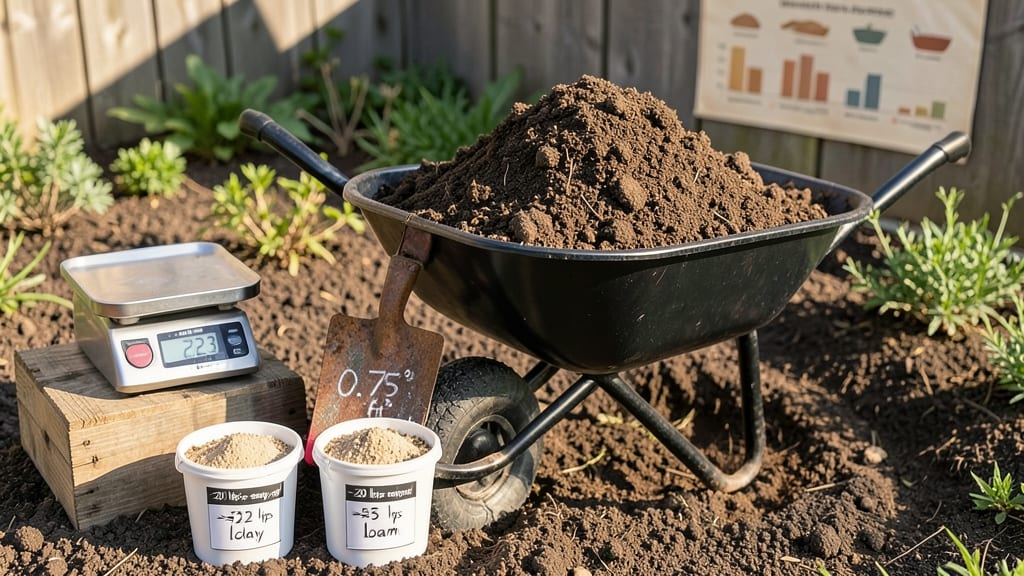
To determine how much 0.75 cubic feet of soil weighs, expect a range of 20 to 45 pounds depending on composition—sandy soil sits at the lighter end (20–30 lbs), while clay-heavy soil can exceed 45 lbs, and moisture levels add up to 50% more weight in saturated conditions.
Understanding soil weight is crucial for projects like raised garden beds or erosion control.
The variation comes down to particle size and density—sandy soils pack loosely, while clay particles bind tightly, increasing weight. 🌱 For example, a cubic foot of wet clay soil might weigh nearly 70 pounds compared to just 25 pounds for dry sand.
Gardeners often adjust calculations by 10-20% when accounting for seasonal moisture changes, which can dramatically alter structural requirements for containers or planters.
Moisture plays a surprising role—water fills soil pores, adding significant bulk. A 10% moisture increase in loamy soil could push its weight from 35 lbs to 50 lbs, requiring stronger supports for heavy planters. Always test your soil's moisture level before estimating weight for critical projects.
💡 In This Article
- Soil Density Breakdown: Why Weight Varies by Type
- Practical Weight Estimates for Gardening Projects
Soil density breakdown: why weight varies by type
Soil weight hinges on particle composition and porosity. Sandy soils have large particles that pack loosely, creating more air pockets and reducing density—think of it like trying to hold a handful of marbles versus clay flakes.
This loose structure explains why dry sand typically weighs just 90-100 pounds per cubic foot, translating to 20-25 pounds for 0.75 cubic feet.
The opposite occurs with clay: its tiny, plate-like particles bind tightly, reducing air space and increasing density to 110-140 pounds per cubic foot, or 40-50 pounds for 0.75 cubic feet.
The magic number here is bulk density, measured in pounds per cubic foot (pcf). Sandy loam averages 100-110 pcf, while clay loam can exceed 120 pcf. Organic matter like compost or peat further complicates things—it adds weight but also increases porosity, creating a lighter yet nutrient-rich soil.
For example, peat moss weighs 35-50 pounds per cubic foot when dry, but swells dramatically when wet, adding 15-20 pounds of water weight per cubic foot in saturated conditions. 🌱
Moisture transforms soil weight more than you'd expect. Water fills the tiny gaps between particles, and clay soils—with their microscopic spaces—can absorb 30-50% of their dry weight in water.
A 30-pound bag of dry loamy soil might become 45 pounds after a rainfall, while the same volume of sandy soil would only gain 10-15 pounds. This is why gardeners in rainy climates often need to reinforce planters or raised beds with heavier supports to handle the extra load.
Porosity—the percentage of air and water space in soil—plays a hidden role. Sandy soils have 40-50% porosity, while clay soils have just 30-40%. This means clay holds more water by volume, increasing weight without changing the total cubic feet.
For instance, a 0.75 cubic foot clay pot might weigh 50 pounds dry but 75 pounds when waterlogged, while the same volume of sandy soil would only jump from 25 to 35 pounds. Understanding these ratios helps gardeners predict soil behavior in containers or landscape projects.
Here’s a quick comparison of bulk densities for common soil types:
- Sandy soil: 90-100 pcf (dry) / 100-110 pcf (moist) → 20-25 lbs for 0.75 cubic feet
- Loamy soil: 100-110 pcf (dry) / 120-130 pcf (moist) → 30-35 lbs for 0.75 cubic feet
- Clay soil: 110-140 pcf (dry) / 140-170 pcf (moist) → 40-50 lbs for 0.75 cubic feet
- Peat moss: 35-50 pcf (dry) / 70-90 pcf (saturated) → 15-25 lbs (dry) / 35-45 lbs (wet)
For gardeners, this means a 5-gallon pot (about 0.25 cubic feet) filled with clay soil could weigh 10-15 pounds dry but double to 20-30 pounds when watered. Always factor in these variations when designing structures or calculating material needs! 💫