
Light Requirements
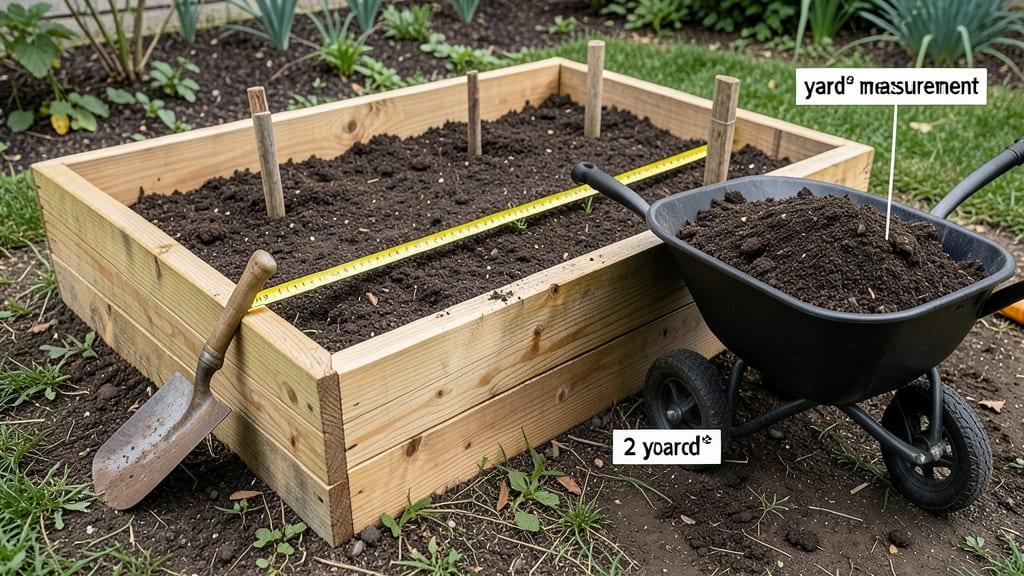
To determine how many yards of soil you need for your garden, multiply its length and width in feet, then divide by 324 (for 1-inch depth) or adjust for deeper planting beds. For example, a 10x10-foot garden at 6 inches deep needs 1.5 cubic yards of soil.
This calculation works because cubic yards measure volume, not just surface area. 🌱 For instance, a 5x10-foot raised bed filled to 12 inches deep requires 1.8 cubic yards—double the soil of a flat garden with the same footprint but only 6 inches of depth.
Always round up to account for compaction, and consider soil type: sandy soil settles more than loamy mixes, which may need extra volume.
Pro tip: Order 10-15% more than your calculation to handle uneven ground or future amendments. If your garden has slopes or curves, break it into rectangles, calculate each section separately, then sum the totals.
For vegetable gardens, prioritize nutrient-rich blends like compost-amended topsoil, while flower beds often thrive with lighter, well-draining mixes.
💡 In This Article
- Calculating Soil Volume by Garden Dimensions
- Choosing the Right Soil Type for Your Project
Calculating soil volume by garden dimensions
At the heart of this calculation is the conversion between square footage and cubic yards, which accounts for depth. One cubic yard equals 27 cubic feet—that's a space measuring 3 feet long × 3 feet wide × 3 feet deep.
When you multiply your garden's length and width in feet, you get square footage, but depth transforms this into volume. Dividing by 324 (which is 27 × 12, since there are 12 inches in a foot) converts square footage at 1-inch depth to cubic yards.
For example, a 10x10-foot garden at 1-inch depth needs 0.30 cubic yards of soil.
The depth factor is where things get interesting. Doubling the depth from 6 inches to 12 inches doesn't just double the soil needed—it quadruples it because volume is a three-dimensional measurement.
A 10x10-foot bed at 6 inches needs 1.5 cubic yards, but at 12 inches, you'll need 3 cubic yards.
This is why raised beds, which often start at 12-18 inches deep, require significantly more soil than in-ground gardens. 🌱 For sloped gardens, break the area into horizontal sections and calculate each separately to avoid underestimating volume.
Soil compaction is another critical factor that often catches gardeners off guard. When soil settles after watering or planting, its volume can shrink by 10-20%. To account for this, always order 10-15% more soil than your calculation suggests.
For instance, if your math says 2.5 cubic yards, round up to 2.8 cubic yards to ensure you have enough for settling and future amendments. This buffer also helps if you decide to add compost or mulch later, which requires additional space.
Irregularly shaped gardens complicate things, but the solution is straightforward: divide the area into rectangles or triangles, calculate each section individually, and sum the results. For example, a kidney-shaped garden might be split into a rectangle and a semicircle.
Measure the diameter of the semicircle, calculate its area (πr²/2), then apply the same depth formula. This method ensures accuracy even for the most unconventional layouts. 💫 Precision here prevents costly last-minute trips to the nursery for extra soil.
For raised beds, consider the frame's height and material. Wooden frames may require 1-2 extra inches of soil depth to account for the frame's thickness, while metal or composite frames are typically flush with the soil line. Always measure the interior dimensions of your raised bed—not the exterior—to avoid overestimating.
For example, a 4x8-foot raised bed with 12-inch sides and a 1-inch frame thickness has an interior space of 3.8x7.8 feet, not 4x8 feet.
Finally, don't overlook the role of soil type in your calculations. Loamy soil, which is rich in organic matter, compacts less than sandy soil but may require more volume if you're mixing in amendments like compost.
Sandy soil, on the other hand, drains quickly but can settle significantly after watering, often requiring 15-20% more volume than loamy mixes. Always check the soil blend's recommended depth from the supplier to fine-tune your order. 🌿