
Light Requirements
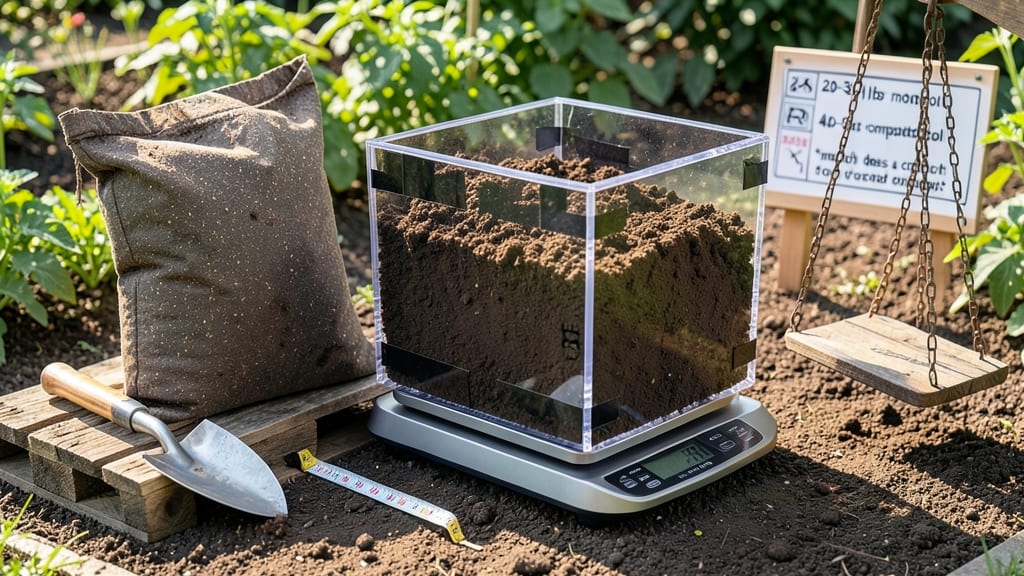
To determine how much a cubic foot of topsoil weighs, expect 40 to 60 pounds as a baseline, though this range shifts dramatically depending on moisture levels, compaction, and organic material—dry, airy soil can drop to 30 pounds, while saturated or tightly packed soil may hit 70 pounds or more.
A cubic foot of topsoil's weight isn't just about the dirt itself—moisture plays the biggest role. Wet soil can weigh nearly double what dry soil does because water adds 1.4 pounds per cubic foot per 1% moisture increase. Compaction from foot traffic or machinery further increases density, squeezing out air pockets that normally lighten the load. 🌱 For gardeners, this means a bag labeled "40 pounds" might actually deliver less usable volume if it's packed tightly.
Understanding these variations helps with everything from estimating delivery costs to calculating how much soil you'll need for raised beds. For example, a 10 cubic foot project could require 300 to 700 pounds depending on soil conditions—knowledge that saves time and money.
Always check moisture levels before purchasing, as even a slight dampness can significantly alter the weight per cubic foot.
💡 In This Article
- Factors Affecting Topsoil Weight per Cubic Foot
- Practical Ways to Estimate Topsoil Weight for Gardening Projects
Factors affecting topsoil weight per cubic foot
Moisture content is the single biggest variable in topsoil weight. Soil particles themselves—sand, silt, and clay—create a framework, but the spaces between them (pores) can hold water weighing up to 1.4 pounds per cubic foot per 1% moisture increase.
For example, a dry soil sample at 5% moisture might weigh 45 pounds per cubic foot, while the same soil saturated to 25% moisture jumps to 65 pounds. This explains why freshly tilled soil often feels heavier than it looks—those pores are filled with water rather than air.
Organic matter plays a secondary but critical role. Decomposed plant material and humus are lighter than mineral particles, but they also retain more moisture. A soil with 10% organic matter can weigh 10-15% less than mineral-heavy soil when dry, but absorb 20% more water when wet.
This dual effect creates the widest weight swings—think of compost-rich garden soil versus pure sand. Particle density matters too: clay soils pack tightly (higher bulk density), while sandy soils stay loose (lower bulk density), directly impacting weight per cubic foot.
Compaction from foot traffic, machinery, or even heavy rainfall forces air out of soil pores, replacing it with water or compressed particles. A 10% compaction increase can add 5-10 pounds per cubic foot by reducing porosity.
This is why construction sites often require soil testing—what looks like 1 cubic yard of loose soil might actually deliver only 0.8 cubic yards when compacted.
The science behind this is bulk density: the ratio of dry soil mass to total volume, which increases as compaction squeezes out air and water fills the gaps.
Temperature also influences weight indirectly. Cold soils hold more water in frozen form, increasing weight until thawing releases ice crystals. In winter, a cubic foot of frozen topsoil might weigh 70+ pounds before melting reduces it to 50 pounds.
Conversely, baked summer soil loses moisture and weighs less—up to 30% lighter than its spring counterpart. These seasonal shifts explain why gardeners often overestimate soil volumes during dry spells or underestimate them after heavy rains.
Here's a practical comparison: A 20-pound bag of potting mix (lighter due to high organic content) expands to about 1 cubic foot, while a 40-pound bag of mineral-heavy topsoil occupies the same space when dry but could weigh 60 pounds if damp.
This discrepancy is why contractors specify "loose cubic yards" for deliveries—what you pay for isn't always what you get when moisture or compaction enters the equation.
For gardeners planning raised beds, this means calculating soil needs requires accounting for all four factors. A 4'x8' bed filled 12" deep holds 32 cubic feet—but that could translate to 1,280 to 2,240 pounds depending on soil conditions.
Always test your soil's moisture by squeezing a handful: if it holds shape but crumbles when pressed (about 20% moisture), you're in the 50-60 pound range. If it feels like a damp sponge (30%+ moisture), expect the upper end of the scale.