
Light Requirements
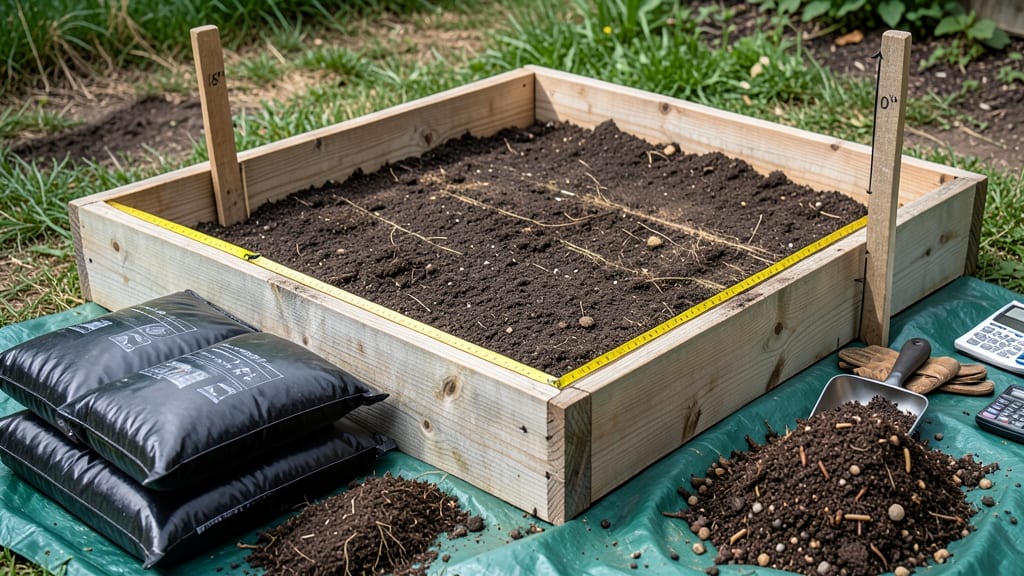
How much soil do I need for a raised bed? Calculating it saved me from buying extra bags and hauling unnecessary weight. 🌱 The right amount means lighter workdays and a garden that thrives from day one—no guesswork, just precision. Start by measuring your bed's length, width, and depth in feet, then multiply those numbers to find cubic feet of soil needed.
Most vegetables need 6-12 inches of soil, while root crops like carrots or potatoes demand 12+ inches. My 4'x8' bed at 10 inches deep needs 27 cubic feet of soil—about 13.5 cubic yards (or 13.5 bags of 2 cubic foot mix).
Layering cheaper materials like straw or leaves under premium soil cuts costs while improving drainage.
You'll avoid the frustration of running out mid-project or wasting money on excess soil. A simple formula—length × width × depth—gives you the exact volume, and breaking it into smaller batches makes hauling easier. For a 4'x8' bed, that’s 32 cubic feet at 12 inches deep, perfect for heavy feeders.
Pro tip: Buy 5-10% extra to account for settling. I learned the hard way—skimping left gaps that needed last-minute top-ups. Now I order a little more and store the extra for next season’s amendments. This method works for any size bed, from tiny 2'x4' containers to massive 8'x12' plots.
📚 In This Guide
- What you need
- Instructions
- Tips and common mistakes
- Wrapping up and next steps
What you need
- ● Raised bed frame: Wood (cedar or redwood recommended), composite lumber, or metal (check local regulations for height limits—typically 12–18 inches for accessibility).
- ● Soil: Topsoil: 60–70% of the mix (aim for 2–3 cubic feet per square foot of bed depth).
- ● Compost: 20–30% (boosts nutrients and drainage).
- ○ Perlite/vermiculite: 5–10% (for aeration; optional but helpful for heavy clay soil).
- ● Tools: Measuring tape
- ● Wheelbarrow or large bin (for mixing soil)
- ● Garden shovel or spade
- ● Level (to ensure your bed is even)
- ● Calculating tool (pen + paper or app like Raised Bed Calculator)
- ● Landscape fabric (to block weeds if placing directly on grass)
- ● Hardware cloth (to deter burrowing pests like gophers)
- ● Soil test kit (to check pH/nutrients before planting)
- ● Garden hose (for post-soil hydration)
Step-by-Step guide to calculating soil for raised beds
Let’s break this down into simple math—no guesswork, just precise measurements.
📏 Step 1: Measure Your Raised Bed Dimensions
Start by measuring the length, width, and depth of your raised bed using a tape measure. Write these numbers down—you’ll need them for calculations. For example, a 4-foot by 8-foot bed that’s 10 inches deep will require a very different soil volume than a 3-foot by 6-foot bed with 12 inches of fill. Always measure the inside dimensions, not the outer frame, since that’s where soil will go.
Pro tip: If your bed has sloping sides, measure the depth at three points (two corners and the center) and average them. This ensures you account for any unevenness. For instance, if one side is 11 inches and the other is 9 inches, use 10 inches as your working depth. Precision here prevents soil shortages mid-project.
📐 Step 2: Convert Depth to Feet for Volume Calculation
Since soil volume is measured in cubic feet, convert your depth from inches to feet. Divide the depth in inches by 12—for example, a 10-inch-deep bed becomes 10 ÷ 12 = 0.83 feet. This step is critical because most soil bags list their volume in cubic feet, and mixing units (inches vs. feet) leads to costly mistakes.
Here’s the formula you’ll use next: Length (ft) × Width (ft) × Depth (ft) = Cubic Feet of Soil. For a 4×8 bed at 10 inches, that’s 4 × 8 × 0.83 = 26.56 cubic feet. Round up to 27 cubic feet—you’ll always need a little extra for settling and amendments.
📦 Step 3: Calculate Total Soil Volume and Adjust for Settling
Multiply your converted depth by the length and width to get the raw cubic feet. For a 3×6 bed at 12 inches (1 ft), that’s 3 × 6 × 1 = 18 cubic feet. But here’s the catch: Soil settles 10–20% after watering. To account for this, multiply your total by 1.2 (20% buffer). So 18 × 1.2 = 21.6 cubic feet—round up to 22 cubic feet for safety.
I always add 5 extra cubic feet for amendments like compost or perlite. For example, if your bed needs 27 cubic feet of base soil, I’ll buy 32 cubic feet total (27 + 5). This ensures you have enough to mix in nutrients without scrambling for extra bags later.
🛒 Step 4: Convert Cubic Feet to Bags and Delivery Options
Now, check the cubic feet per bag on your soil purchase. A 2-cubic-foot bag means you’ll need 16 bags for a 32-cubic-foot bed (32 ÷ 2 = 16). But bulk delivery (often sold by the cubic yard) is cheaper for large beds. One cubic yard equals 27 cubic feet, so 32 ÷ 27 ≈ 1.2 cubic yards. Order 1.25 cubic yards to cover settling and amendments.
Real talk: Delivery fees add up quickly. For beds under 15 cubic feet, buying 2-cubic-foot bags is often cheaper than ordering bulk. Use this rule of thumb—if your total is under 20 cubic feet, bags win; over 25, bulk saves money. Always call ahead to confirm delivery access to your yard.
⚠️ Step 5: Account for Existing Soil and Layering
If your raised bed sits on grass or hardpan, you’ll need 2–4 extra inches of depth to bury the grass or lay landscape fabric. For example, a 10-inch-deep bed might require 12–14 inches total after accounting for this layer. Double-check your local building codes—some areas mandate a minimum 6-inch soil depth for plant roots.
For layered beds (like straw bale or hugelkultur), calculate each layer separately. For instance, a 4-inch straw layer in a 4×8 bed adds 4 × 8 × (4 ÷ 12) = 10.67 cubic feet. Add this to your soil total. I’ve seen gardeners skip this step and end up with half the depth they thought they had—don’t let that be you.
Tips & tricks for calculating soil volume for raised beds
Precision is everything when calculating soil volume—here's how to avoid common missteps that lead to shortages or wasted money.
Precision in Measurement: When measuring your raised bed's depth in Step 1, use a level to verify the height at multiple points. I've seen beds where one corner sits 2 inches higher than the opposite—this can throw off your entire calculation. For beds with uneven sides, take three measurements (corners and center) and average them. This ensures your depth conversion in Step 2 remains accurate, especially when dealing with beds over 12 inches deep where even small variations matter significantly.
Conversion Accuracy: The depth-to-feet conversion in Step 2 is where many gardeners make mistakes. Always divide inches by 12—not by 10 or 11—because soil volume calculations rely on precise cubic feet measurements. For example, a 10-inch bed converts to 0.83 feet (10 ÷ 12), not 1 foot. I recommend writing this down immediately after measuring to prevent mental math errors that could cost you 10-15% of your soil volume.
Settling Factor: The 10-20% settling adjustment in Step 3 is non-negotiable for long-term success. Organic soils compress significantly after watering, especially in the first few weeks. I've seen raised beds lose 30% of their initial volume when gardeners ignore this. For beds over 18 cubic feet, consider adding an extra 5% buffer—this accounts for both settling and any unexpected amendments you might want to add later. The key is to multiply your raw cubic feet by 1.2 (20% buffer) before purchasing anything.
Layered Bed Strategy: If you're creating layered beds (like hugelkultur or straw bale systems) mentioned in Step 5, calculate each layer's volume separately before combining totals. For example, a 4-inch straw layer in a 4×8 bed adds 10.67 cubic feet—don't assume this will be covered by your base soil calculation. I keep a running total on a notepad as I measure each layer to avoid the shock of realizing you're short 20 bags of soil halfway through the project.
Pro Tips for How Much Soil Do I Need For A Raised Bed
- Precision is everything when calculating soil volume—here's how to avoid common missteps that lead to shortages or wasted money.
- Precision in Measurement: When measuring your raised bed's depth in Step 1, use a level to verify the height at multiple points.
- Conversion Accuracy: The depth-to-feet conversion in Step 2 is where many gardeners make mistakes.
Frequently asked questions
Got questions about soil volume for your raised beds? You’re not alone! Here are answers to the most common concerns to help you plan like a pro.
How do I calculate soil for irregularly shaped raised beds?
Break your bed into simple shapes (rectangles, squares) and calculate each section separately. Add the volumes together for the total. For example, a bed with a curved side can be split into a rectangle and a trapezoid—measure the lengths and depths, then use the formula length × width × depth for each part.
Can I reuse soil from my garden in a raised bed?
Yes, but mix it with fresh soil or compost (aim for 20-30% compost) to improve drainage and fertility. Avoid heavy clay or compacted soil—it can suffocate roots. Test your garden soil first; if it’s poor, supplement with high-quality topsoil or potting mix.
What’s the best time of year to add soil to a raised bed?
Spring or early fall are ideal—soil is workable, and plants can establish roots before extreme weather. Avoid winter (unless in mild climates) or peak summer heat, which can dry out soil too quickly. If starting late, use mulch to retain moisture and protect new soil.
Is it cheaper to buy bags of soil or bulk topsoil?
Bulk topsoil is usually 30-50% cheaper per cubic foot, but bags (like 2 cu. ft. bags) offer convenience and consistency. For large beds, rent a delivery truck or borrow a tractor to haul bulk soil. Weigh the cost vs. labor—sometimes bags save time and hassle!
My raised bed soil smells bad—what’s wrong?
Bad smells often mean too much organic matter decomposing at once or poor drainage. Fluff the soil, add coarse materials (like perlite or sand), and mix in dried leaves or straw to balance moisture. Avoid over-watering, and consider adding lime if the soil is acidic (pH < 6.0).
Can I use just compost instead of soil in a raised bed?
Compost alone can compact over time and lack structure, but it’s great as a 50% mix with topsoil or coco coir. For best results, layer 1/3 compost, 1/3 topsoil, and 1/3 perlite/sand to improve aeration and drainage. Pure compost works short-term but may need replenishing yearly.
Wrapping up and next steps
Calculating the right amount of soil for your raised bed is simple once you know the basics! Whether you’re a seasoned gardener or just starting out, measure your bed’s dimensions, factor in depth, and adjust for drainage—you’ve got this.
Now that you’re armed with the know-how, it’s time to get your hands dirty and turn that empty frame into a thriving garden oasis.
🌱 Next step: Grab your measuring tape, pick up some high-quality soil mix, and start planting! Happy gardening—your future harvest will thank you.