
How To
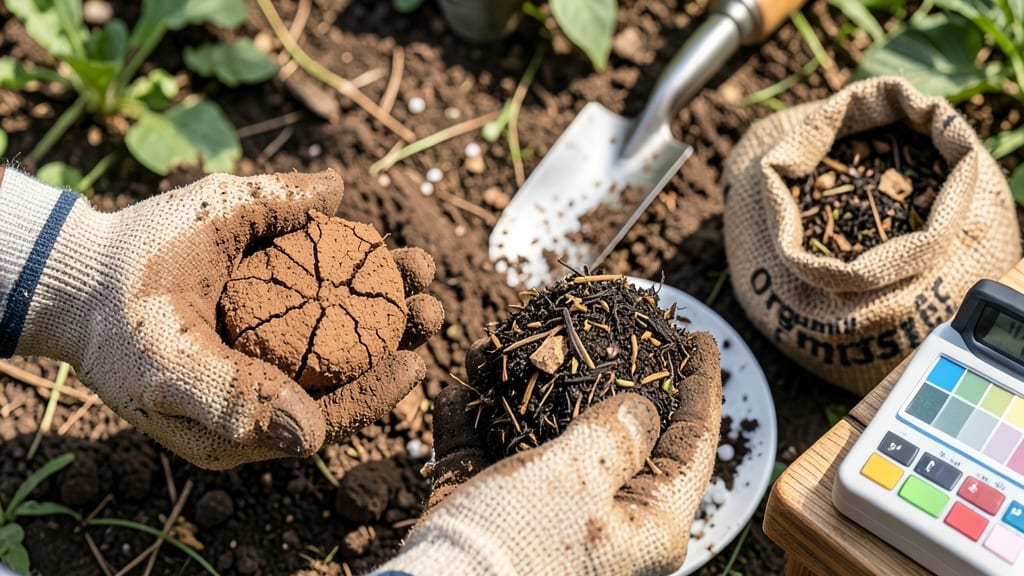
When soil has a high clay content, it becomes dense and waterlogged, but you can improve it by incorporating compost, mixing in coarse sand or perlite, and planting deep-rooted crops to break up compaction over time. Avoid tilling heavily to prevent making the problem worse.
Clay soil's tiny, tightly packed particles create a brick-like structure that blocks water drainage and smothers roots by cutting off oxygen. 🌱 The result? Plants struggle to absorb nutrients even when the soil looks moist.
Unlike sandy soil, which drains too quickly, or loamy soil, which balances everything perfectly, clay holds water like a sponge but suffocates roots in the process. The key is to gradually introduce organic matter and structural amendments to create air pockets without disrupting the soil's natural microbial life.
To make real progress, focus on layering improvements rather than quick fixes. For example, spread 2-3 inches of compost over the surface and lightly fork it in during cooler months when soil is workable.
Mixing in coarse sand or perlite (about 10-20% by volume) helps create channels for water movement, while deep-rooted plants like clover or alfalfa naturally aerate the soil over time. The goal is to transform dense clay into a looser, more forgiving growing medium that retains moisture without drowning roots.
💡 In This Article
- How Clay Soil Affects Plant Roots and Water Retention
- Step-by-Step Clay Soil Amendments for Better Gardens
How clay soil affects plant roots and water retention
Clay particles are flat and plate-like, measuring just 0.002 millimeters in diameter—about 1/100th the width of a human hair. When wet, these particles swell and stick together like a brick wall, creating tiny pores that trap water but block air.
This is why clay soil often feels slick and sticky when moist yet cracks into hard clods when dry.
The microscopic gaps between particles are too small to allow oxygen diffusion, which is critical for root respiration. 🌱 In contrast, sandy soil has larger particles with big air pockets but drains water too quickly, while loamy soil strikes the perfect balance with a mix of particle sizes.
The water retention issue stems from clay's high cation exchange capacity (CEC), which lets it hold nutrients tightly—but also prevents roots from accessing them efficiently.
When clay soil stays saturated, roots suffocate because oxygen levels drop below 10% (ideal is 20-25%), triggering anaerobic conditions that produce toxic compounds like ethanol and hydrogen sulfide. This explains why plants in clay soil often show yellowing leaves or stunted growth despite appearing "wet enough."
The paradox is that clay's moisture retention becomes a liability when it prevents proper drainage.
Consider how water moves through different soils: in clay, it pools at the surface like a puddle because the dense structure acts as a barrier. Even after heavy rain, clay soil may remain waterlogged for days or weeks, while sandy soil drains within hours.
The solution lies in creating macropores—larger air channels—that allow water to percolate downward. Organic matter like compost achieves this by forming aggregates (clumps) that hold space between particles, while sand or perlite physically separates clay plates to increase pore volume.
One often-overlooked factor is the pH sensitivity of clay soils. Their high CEC means they buffer pH changes poorly, often becoming acidic (pH 5.5 or lower) when organic matter decomposes. This acidity locks up nutrients like phosphorus and iron, making them unavailable to plants.
Testing your soil's pH before amending is crucial—aim for a range of 6.0-7.0 to unlock nutrient accessibility while improving structure. 💫
For visual comparison, imagine three glasses: one filled with clay (water sits on top), one with sand (water drains instantly), and one with loam (water moves steadily).
The goal is to transform your clay soil into something closer to that middle glass—where water is retained long enough for roots to absorb it but not so long that roots drown. This balance is what separates struggling gardens from thriving ones in heavy clay conditions.
What most gardeners don't realize is that clay's density also affects soil temperature. Dark clay absorbs heat rapidly, creating a 5-10°F warmer microclimate at the surface compared to sandy soil. While this can extend growing seasons in cool climates, it also increases evaporation rates, making moisture management even more critical.
The key is to work with these natural properties rather than against them—using mulch to moderate temperature swings while improving internal structure.