
Plants
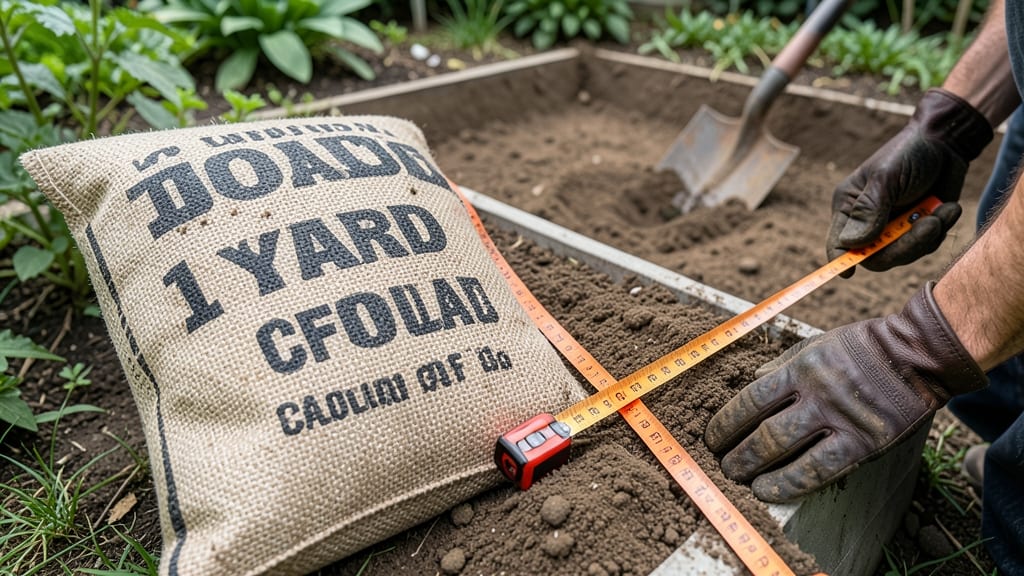
One yard of soil looks like a dense, cubic pile measuring 3 feet long, 3 feet wide, and 3 feet tall, weighing between 1,800 to 2,200 pounds when dry. Its exact weight depends on composition—sandy soil is lighter (~1,600 lbs), while clay-heavy soil can exceed 2,400 lbs. When moist, the weight jumps by 20-50%, making it significantly heavier.
Visualizing a cubic yard of soil helps put this weight into perspective—it's roughly the size of a large trash can but packed with enough mass to require heavy-duty equipment for moving. 🌱 The composition plays a huge role: sandy soil feels lighter because its particles are loose and airy, while clay-heavy soil is dense and compact.
Even a small change in moisture can drastically alter the weight, which is why gardeners often order extra soil for projects to account for unexpected variations.
For practical purposes, this means you'll need a sturdy wheelbarrow or truck to transport it safely. I always recommend breaking larger piles into smaller sections to avoid straining your back, especially when dealing with moist soil that can weigh over 2,000 pounds per yard.
Planning ahead for these weight differences can save you time and effort during landscaping projects.
💡 In This Article
- Soil Weight Variations by Composition and Moisture
- Practical Tips for Handling and Transporting 1 Yard of Soil
Soil weight variations by composition and moisture
Soil isn't just dirt—it's a complex mix of mineral particles, organic matter, and pore spaces that dramatically affect its weight. The three primary components—sand, silt, and clay—each contribute differently.
Sandy soil has the largest particles (0.05-2mm) with high air spaces, giving it a loose structure that weighs about 1,600-1,800 pounds per cubic yard when dry.
Clay soil, with particles smaller than 0.002mm, packs tightly, increasing density and weight to 2,200-2,400 pounds—nearly 50% heavier than sand. 🌱
The organic matter content also plays a crucial role. Compost-rich soil contains decomposed plant material that adds bulk but reduces overall weight compared to pure mineral soil.
For example, a mix with 20% organic matter might weigh 1,500-1,900 pounds per yard, while pure mineral soil without organics can approach 2,500 pounds when clay-dominated. Moisture is the wild card—water fills those pore spaces, adding 20-50% more weight by displacing air.
Compaction further complicates things. When soil is tamped down—like in construction sites or after heavy rain—its volume decreases while weight remains constant, making it feel even heavier. A 10% compaction can increase perceived weight by 15-20% due to reduced volume.
This is why a "yard" of freshly delivered soil might feel lighter than the same amount after a few days of settling. 💫
Here's how different soil types compare in real-world scenarios:
- Sandy loam: 1,600-1,800 lbs (ideal for drainage, lighter to handle)
- Loamy soil (balanced): 1,800-2,100 lbs (most common garden soil)
- Clay-heavy: 2,200-2,400 lbs (dense, harder to move)
- Peat moss (organic): 1,200-1,500 lbs (light but absorbs moisture)
Understanding these variations helps explain why a "yard" of soil can feel deceptively heavy—especially when damp. For instance, what seems like a manageable 1,800-pound pile of dry loam can balloon to 2,700 pounds when saturated.
This weight shift is why professionals always specify "dry weight" when ordering bulk soil for projects. 🚜
The science behind this involves porosity—the space between particles. Sandy soils have 40-50% porosity, while clay soils have only 30-40%, meaning they hold more water and feel heavier. Organic soils can have 50-70% porosity, making them lighter but more prone to weight gain when wet.
This explains why a "yard" of peat moss might feel surprisingly light until it absorbs moisture.