
Landscaping
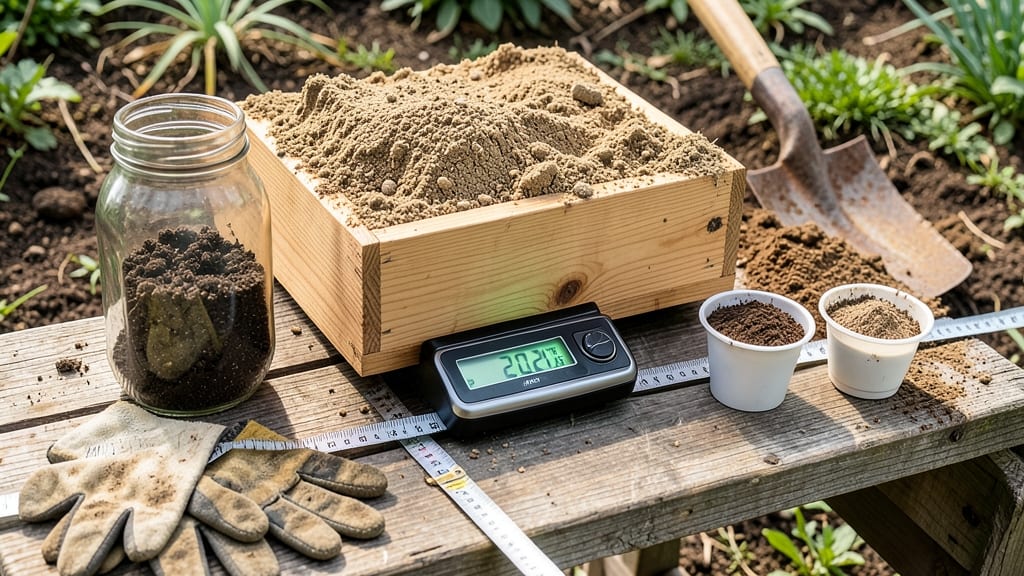
The weight of soil per cubic yard varies by type: dry topsoil weighs 1,800–2,200 pounds, clay soil 2,400–2,800 pounds, and sandy soil 2,200–2,600 pounds, with moisture increasing weight by 50–100 pounds per cubic yard depending on saturation levels. Loam soil typically falls between 2,000–2,400 pounds when dry.
Understanding soil weight is key for landscaping projects, especially when calculating how much your truck can haul or how much structural support your garden beds need. 🌱 The differences come down to particle size and moisture content—clay particles pack tightly, making clay soil the heaviest, while sandy soil has larger gaps that reduce overall weight.
Even a small change in moisture can shift the weight by up to 100 pounds per cubic yard, so checking soil dampness before moving it is a must.
For practical purposes, I always recommend testing soil moisture before estimating weight—wet soil can be significantly heavier than dry. This is especially important when planning large projects like raised beds or erosion control, where weight affects both material costs and installation logistics.
💡 In This Article
- How Soil Composition Affects Weight Per Cubic Yard
- Practical Weight Calculations for Gardening Projects
How soil composition affects weight per cubic yard
Soil weight per cubic yard is fundamentally determined by its particle composition and porosity. Clay particles are microscopic and tightly packed, creating dense structures that can weigh up to 2,800 pounds when dry.
In contrast, sandy soil has larger, loosely arranged particles with air pockets, reducing its weight to around 2,200–2,600 pounds. This difference occurs because clay's minuscule particles have far more surface area for water absorption, while sand's larger grains repel moisture more effectively. 🌱
The presence of organic matter—like decomposed plant material—also plays a critical role. Peat soil, for example, contains up to 90% organic material and can weigh as little as 1,200 pounds per cubic yard when dry due to its fibrous, lightweight structure.
Meanwhile, loam—a balanced mix of sand, silt, and clay—typically sits between 2,000–2,400 pounds, offering a middle-ground density ideal for gardening. The key factor here is how these components interact: clay binds tightly, sand resists compaction, and organic matter adds bulk without significant weight.
Moisture is the wild card in soil weight calculations. A cubic yard of dry clay might weigh 2,400 pounds, but when saturated, it can surge to 2,800 pounds or more—a 16% increase due to water's density.
Sandy soil shows less dramatic changes (typically 50–100 pounds gain), but even small moisture variations matter. This is why professionals use moisture meters to adjust weight estimates before transporting soil, especially for projects requiring precise calculations like retaining walls or heavy planters. 💧
Particle size distribution also affects how soil behaves under pressure. Clay's fine texture makes it prone to compaction, increasing weight over time, while sandy soil remains more stable. For instance, a 10% compaction increase in clay soil can add 200–300 pounds per cubic yard—a critical consideration for structural projects.
Understanding these mechanics helps gardeners and contractors avoid costly overestimations or structural failures.
Consider this real-world example: A 10-foot by 10-foot raised bed filled with 12 inches of loam soil contains roughly 0.67 cubic yards. If dry, that's about 1,340–1,600 pounds—enough to stress weak wooden frames.
But if the soil is moist, the weight jumps to 1,500–1,800 pounds, requiring reinforced supports. This is why moisture testing is non-negotiable for large-scale projects. 🏗️
Even seemingly minor variations—like the presence of 5% silt in loam—can shift weight by 50–100 pounds per cubic yard. For precision, lab testing (e.g., hydrometer analysis) reveals exact particle ratios, but field tests like the ribbon test (clay) or jar test (sand/silt) provide quick estimates.
Knowing these nuances ensures your weight calculations stay accurate, whether you're planning a backyard garden or a commercial landscape. 🔍