
How To
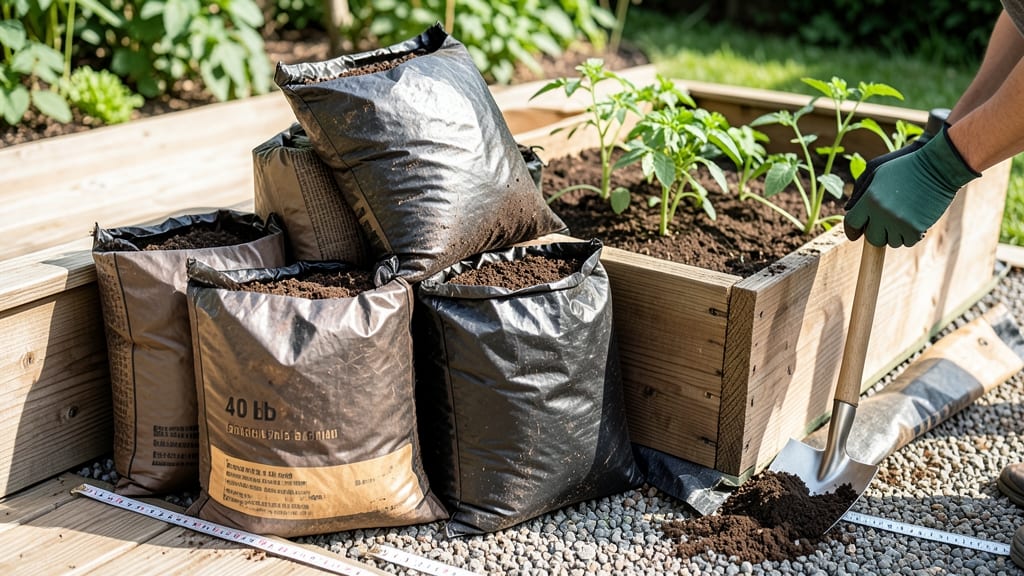
Calculating how many bags of soil for a raised bed requires knowing your bed's length, width, and fill depth. A typical 4’x8’ raised bed filled 6–12 inches deep needs 32–64 bags of 2 cubic foot soil (or 16–32 bags of 4 cubic foot bags). Use the formula: multiply length × width × depth (in feet) by 0.33 (for 2 cu ft bags) or 0.67 (for 4 cu ft bags) to get your exact total.
Figuring out the right amount of soil for your raised garden prevents waste and ensures your plants get the perfect growing environment. 🌱 The key is converting your bed's dimensions into cubic feet—this accounts for how much space your soil will actually occupy after settling.
For example, a 3’x6’ bed filled 10 inches deep needs about 18 bags of 2 cu ft soil, while deeper beds or larger plots will naturally require more. I always recommend buying 10% extra to account for settling and future top-dressing needs.
Another factor to consider is soil type—potting mixes are lighter than native soil, so they may require slightly more volume. If you're mixing your own blend, factor in the bulk of compost or amendments too.
Pro tip: measure your bed's interior dimensions, not the outer frame, as the wood itself takes up space. This small adjustment can save you from buying unnecessary bags while ensuring your plants have enough root room to thrive.
💡 In This Article
- Calculating Raised Bed Soil Volume by Dimensions
- Best Soil Types and Bag Sizes for Raised Garden Beds
Calculating raised bed soil volume by dimensions
To determine how much soil your raised bed needs, start by measuring its interior length, width, and depth in feet—not the outer frame dimensions. For example, a 4’x8’ bed filled 10 inches deep translates to 0.83 feet (10 ÷ 12).
Multiply these dimensions: 4 × 8 × 0.83 = 26.56 cubic feet of space. This raw volume shrinks when soil settles—typically by 10-20%—so account for that by adding 10% extra to your calculation. 🌱
The conversion factor comes from bag size: each 2 cubic foot bag covers about 0.33 cubic feet per inch of depth (since 2 ÷ 6 = 0.33), while 4 cubic foot bags cover 0.67 cubic feet per inch.
Using our 26.56 cubic feet example, you’d need 80 bags of 2 cu ft soil (26.56 ÷ 0.33) or 40 bags of 4 cu ft soil (26.56 ÷ 0.67). Irregularly shaped beds? Divide them into rectangles, calculate each section separately, then sum the totals.
Soil compaction varies by type—potting mixes settle less than native soil (which can compact up to 30% when wet). For heavy clay or loam mixes, add an extra 15% to your total. Pro tip: Use a tape measure to verify depth at multiple points—some beds slope or have uneven bottoms.
For instance, a 3’x6’ bed with 8-inch sides and a 4-inch center depth would need 24 bags of 2 cu ft soil (accounting for the average depth).
Depth matters more than most gardeners realize. Root crops like carrots need 12+ inches of soil, while shallow-rooted herbs thrive in 6-inch layers. A 4’x8’ bed at 6 inches deep holds 16 cubic feet, while the same bed at 12 inches doubles to 32 cubic feet.
This explains why deeper beds require significantly more soil—yet they also improve drainage and reduce weed pressure. 💫
For precision, use this formula: (Length × Width × Depth in feet) × 1.1 (settling factor) = Total cubic feet needed. Then divide by the bag size (2 or 4 cu ft) to get your bag count.
For example, a 5’x10’ bed at 10 inches deep needs 45.8 cubic feet (5 × 10 × 0.83 × 1.1), which equals 138 bags of 2 cu ft soil or 69 bags of 4 cu ft soil. Always round up to the nearest whole bag.
Why the 10% buffer? Soil settles unevenly when watered, and top-dressing with compost later reduces future maintenance. I’ve seen gardens where skimpiness led to poor drainage or exposed roots—never worth the short-term savings.
For raised beds wider than 4 feet, consider dividing them into sections to avoid overloading the soil with too much weight at once.