
Light Requirements
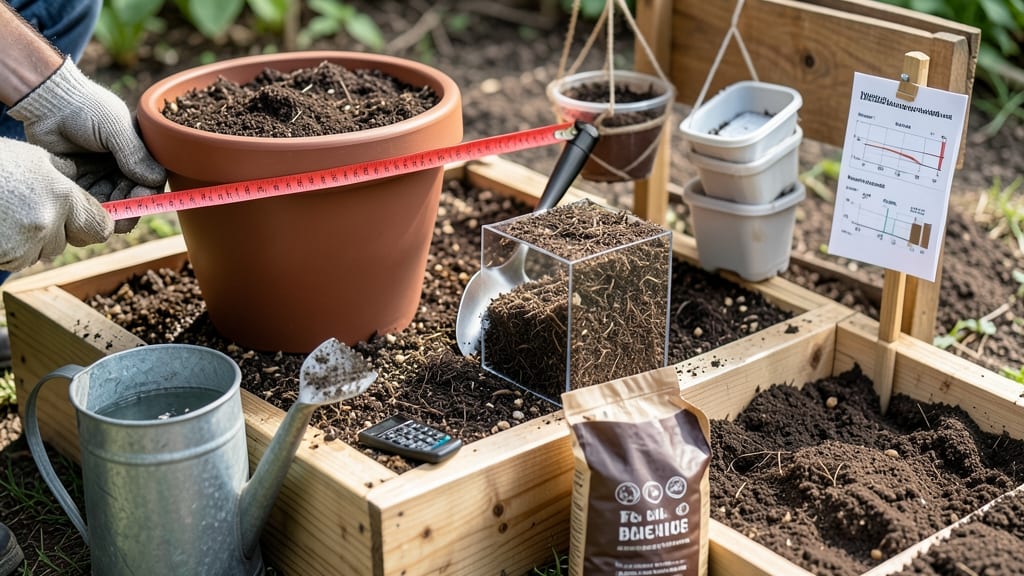
To determine how much soil you need, multiply your container’s length, width, and depth in feet, then subtract any space taken by plants or drainage layers. For garden beds, use the same formula but adjust for existing soil depth and any amendments you’ll add.
Soil volume isn’t just about container size—it’s about creating the right growing environment.
For containers, I always recommend leaving 1-2 inches of space at the top for watering and adding mulch. 🌱 In garden beds, existing soil quality matters more than you’d think: compacted or clay-heavy soil may require 2-3 inches of fresh topsoil to improve drainage and nutrient availability.
Pro tip: If your plants need extra room for roots, add 10-15% more soil than your calculation suggests.
For example, a 2-foot-deep raised bed that’s 4 feet long and 3 feet wide needs 24 cubic feet of soil, but if you’re replacing poor-quality soil, you might need 30 cubic feet to account for amendments like compost or perlite.
Always check your bag’s cubic-foot markings—many brands overestimate volume when compressed.
💡 In This Article
- Calculating Soil Volume for Containers and Raised Beds
- Factors Affecting Soil Quantity in Garden Beds
Calculating soil volume for containers and raised beds
Let's break down the actual calculation process. First, you'll need to measure your container's interior dimensions in feet—not inches—because soil volume is typically sold in cubic feet.
For example, a rectangular planter that's 24 inches long, 12 inches wide, and 12 inches deep converts to 2 feet × 1 foot × 1 foot. Multiply these numbers: 2 × 1 × 1 = 2 cubic feet.
This is your baseline volume before any adjustments. 🌱
The tricky part comes when accounting for drainage layers. Most containers require a 2-3 inch drainage layer at the bottom (like gravel or broken pottery shards), which takes up space.
For our 2-foot-deep example, subtract 0.25 feet (3 inches) from the depth: 1 foot - 0.25 feet = 0.75 feet. Now your calculation becomes 2 × 1 × 0.75 = 1.5 cubic feet of actual soil needed.
Pro tip: Use a tape measure with a level to ensure consistent depth measurements across large containers.
For raised beds, the process is similar but scaled up. A 4-foot × 3-foot × 1-foot bed requires 12 cubic feet of soil, but if you're replacing existing poor-quality soil, you'll need to account for compaction.
Compacted soil can reduce usable space by up to 30%, so add 15-20% more soil to ensure proper root growth. 💫 Think of it like packing a suitcase—tightly packed soil leaves less room for roots to expand.
Here's where many gardeners go wrong: they don't account for plants already in the container. A mature tomato plant might take up 1 cubic foot of root space alone. For containers, subtract this volume from your total.
In our 2-cubic-foot example, if you're planting a basil plant that needs 0.5 cubic feet, your actual soil requirement drops to 1.5 cubic feet. Always check plant tags for root zone requirements—they're often listed as "spreading width × depth."
Let's talk about soil amendments that can change your calculations. Adding 20% compost by volume to improve fertility means you'll need to buy 20% more soil than your initial calculation.
For our 1.5-cubic-foot container example, that means purchasing 1.8 cubic feet of soil. 🔥 Most bagged soils list their volume when loose—when settled, they can compact by 10-15%, so overestimating is always better than coming up short.
For irregularly shaped containers like half-barrels or window boxes, divide them into rectangular sections. Measure each section separately, calculate their individual volumes, then sum them up.
A half-barrel with a 2-foot diameter and 1.5-foot depth (minus 3-inch drainage layer) would be calculated as two 1-foot × 1-foot × 1.25-foot sections: 1 × 1 × 1.25 × 2 = 2.5 cubic feet. This method works for any complex shape.
Remember this key principle: soil volume calculations are about creating a functional growing space, not just filling a container. The goal is to provide 1-2 inches of space between plant roots and container walls for optimal air circulation and moisture retention.
This buffer zone is crucial for preventing root rot in dense soils. 💫