
Landscaping
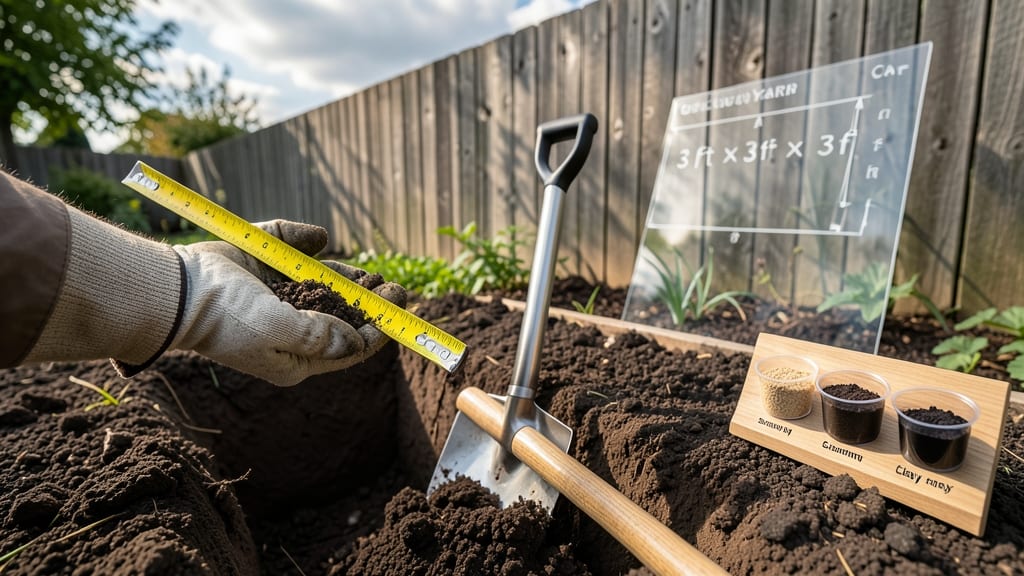
A yard of soil measurement refers to one cubic yard (3 feet x 3 feet x 3 feet), weighing 1,600–2,200 pounds when dry, though moisture and soil type (clay, loam, sand) can significantly alter weight—sandy soil is lighter, while clay-heavy soil is denser and heavier. Always verify with local suppliers for precise calculations before ordering bulk soil for gardening projects.
A cubic yard of soil isn't just about volume—it's a balancing act between composition and moisture.
Clay soils pack in heavier due to their dense particles, while sandy soils stay lighter but drain faster. 🌱 When wet, weight can jump by 50% or more, so suppliers often quote dry weight—always ask if they account for moisture.
For example, a loamy soil (ideal for gardens) typically falls in the mid-range, but a heavy clay mix might tip the scales closer to 2,200 pounds when saturated.
Understanding this helps avoid costly mistakes. A 10-foot-by-10-foot garden bed filled to 6 inches deep needs about 0.3 cubic yards of soil—but if your local mix is clay-heavy, you might need to adjust for compaction.
Pro tip: Order 10-15% more than calculated to account for settling and moisture variations. Most suppliers sell by the cubic yard, so knowing your soil type and moisture conditions keeps your project on track.
💡 In This Article
- How Soil Composition Affects Cubic Yard Weight
- Calculating Soil Needs for Garden Beds and Landscaping
How soil composition affects cubic yard weight
Soil weight isn't just about volume—it's a science of particle density and moisture retention.
Sandy soils have larger particles with more air gaps, giving them a loose structure that weighs about 1,600 pounds per cubic yard when dry. 🌊 In contrast, clay soils pack tightly with tiny particles that trap water and organic matter, often reaching 2,200 pounds per cubic yard when saturated.
Loam, the ideal garden soil, falls between these extremes with a balanced mix of sand, silt, and clay.
The key factor is porosity. Sandy soils drain quickly but hold less water, while clay soils retain moisture like a sponge. When wet, clay can absorb up to 50% more water by weight, dramatically increasing its total mass.
For example, a cubic yard of dry clay might weigh 1,800 pounds, but after rain, it could swell to 2,700 pounds—that's an extra 900 pounds of water! Organic matter also plays a role, as decomposed plant material adds lightweight but moisture-holding components.
Compaction matters too. Foot traffic or machinery can compress soil, reducing air pockets and increasing density. A well-trodden clay area might weigh 20-30% more than loose soil.
This is why professional landscapers often specify "loose" or "compacted" soil when ordering—it directly impacts how much you'll need for projects like raised beds or slopes. 💡 Understanding these variations helps you avoid underestimating weight, especially when moving soil with wheelbarrows or trucks.
Here's a quick comparison of dry weights per cubic yard:
- Sandy soil: 1,600 pounds (lightest, drains fast)
- Loamy soil: 1,800-2,000 pounds (balanced, ideal for gardens)
- Clay soil: 2,000-2,200 pounds (heaviest, retains moisture)
Moisture adds another layer. A cubic yard of soil with 30% water content (typical after rain) can weigh 500-1,000 pounds more than when bone-dry. This is why suppliers often quote "dry weight"—always confirm whether their measurements include moisture or not.
For accuracy, ask for a moisture-adjusted weight if your project involves wet conditions.
What most people don't realize is how organic content affects weight too.
Peat moss or compost can reduce overall density, making a cubic yard feel lighter even if the volume stays the same. 🌱 For example, a mix with 20% compost might weigh 1,500 pounds instead of 2,000 pounds—a critical difference when calculating for large projects.